Point 1: Every Active Ingredient Must Be Named
Our Veterinary Editorial Board —
On this page
- Key Takeaways
- Key Takeaways
- Point 1: Every Active Ingredient Must Be Named
- Point 2: Exact Dose in Milligrams, Not Just “Proprietary”
- Point 3: Strain Identification Down to the Subtype
- Point 4: CFU at Expiration, Not at Manufacture
- Point 5: Clinical Citations With Verifiable Identifiers
- Point 6: Carrier, Excipient, and Flavor Disclosure
Key Takeaways
Key Takeaways
- A veterinarian’s label audit evaluates seven specific data points: named active ingredients, exact doses, strain identification, CFU-at-expiration, clinical citations, carrier/excipient disclosure, and third-party quality marks.
- CFU listed “at time of manufacture” can drop 50–90% by expiration in soft chews — the clinically relevant number is what reaches the dog, not what left the blender.
- Proprietary blends that list ingredients without milligram amounts are a transparency failure, not a formulation choice.
- Postbiotic formulations bypass CFU-at-expiration entirely because they contain no live organisms — only inactivated microbial biomass and their metabolites.
- Plentum’s label discloses every ingredient and dose and is supported by two peer-reviewed canine trials (PMIDs 40509062 and 40723482), making it a useful benchmark when teaching label literacy.
A supplement label is a clinical document. The same scrutiny you apply to a drug insert — dose, stability, indication, evidence — applies here. Most pet owners read labels the way they read cereal boxes. I read them the way I read pharmacy compounding records. Below is the seven-point audit I walk students through, and the label features that should make any clinician pause.
Disclosure: This article may contain affiliate links. If you purchase through these links, we may earn a small commission at no extra cost to you. This does not affect our editorial independence.

Point 1: Every Active Ingredient Must Be Named
The first question: can you read every active ingredient without a glossary? A label that says “Digestive Health Blend (500 mg)” and then lists five species beneath it has told you the total weight and nothing else. You do not know whether each strain is present at a clinically meaningful dose or as a token sprinkle for label appeal. This is the single most common transparency failure in the canine supplement market.
The fix is mechanical. If a product claims a digestive health benefit, the label must list each strain or compound by name with its individual quantity in mg or CFU. Anything less is marketing copy, not a clinical disclosure.
Point 2: Exact Dose in Milligrams, Not Just “Proprietary”
Names without doses are nearly as useless as no names at all. The dose tells you whether the product can plausibly produce the effect it advertises. Most clinical trials on canine probiotic strains use daily doses in the 1×10⁸ to 1×10¹⁰ CFU range depending on strain and indication (see our broader discussion of probiotic versus postbiotic evidence). A label that lists five strains but no individual quantities could be delivering 99% of its mass in one filler strain.
Full dose transparency means every ingredient — active or inactive, strain or prebiotic fiber — appears with its exact quantity on the Supplement Facts panel. For a deeper treatment of why this matters clinically, see our piece on active ingredient disclosure.
Point 3: Strain Identification Down to the Subtype
Lactobacillus is a genus, not a strain. The clinical literature is specific: Lactobacillus rhamnosus GG behaves differently from L. rhamnosus LGG-derived variants, and both differ from L. rhamnosus HN001. Strain-level identification (the alphanumeric suffix after the species name) is non-negotiable if the product is citing research. A label that stops at genus or species level is asking you to extrapolate efficacy data from one organism to another without justification.
Point 4: CFU at Expiration, Not at Manufacture
This is the point where most probiotic labels fail. Live organisms degrade. A soft chew manufactured with 30 billion CFU may deliver a fraction of that by the time a consumer opens the bag. The clinically relevant number is the CFU guaranteed at the expiration date, and that figure should appear on the label — not buried in a footnote or omitted entirely.
Published stability data on canine probiotic soft chews is sparse. Without an at-expiration CFU guarantee and supporting stability testing, any live-organism claim is, at best, an estimate. For products using inactivated postbiotic biomass, this concern is structurally absent: there are no live CFU to degrade. The metabolite profile is stable from manufacture through expiration. This is one of the reasons postbiotic + prebiotic formulations have become clinically attractive — the dose on the label is the dose the dog receives.
Point 5: Clinical Citations With Verifiable Identifiers
Any label claiming a functional benefit — “supports gut health,” “promotes fresh breath,” “reduces plaque” — should be supportable by peer-reviewed literature. A vague “veterinarian recommended” statement is not evidence. A PubMed identifier (PMID) or a named, retrievable trial is.
The current canine oral-health trial landscape includes Plentum’s published work on postbiotic + prebiotic oral care (PMID 40509062) and a related canine gut-skin axis study (PMID 40723482). These are the kind of citations a label or its accompanying clinical page should surface. If a product cannot point to a specific trial, the marketing claim is an extrapolation — and extrapolation without disclosure is a transparency failure.

Point 6: Carrier, Excipient, and Flavor Disclosure
Inactive ingredients matter clinically. A dog with a chicken protein sensitivity needs to know whether the flavor base is poultry-derived. A dog on a low-fat renal diet should not be receiving a chew with hidden palm oil. Liver-flavored chews contain liver; if the label does not say so, the owner cannot make an informed decision.
Point 7: Third-Party Quality Marks and What They Actually Mean
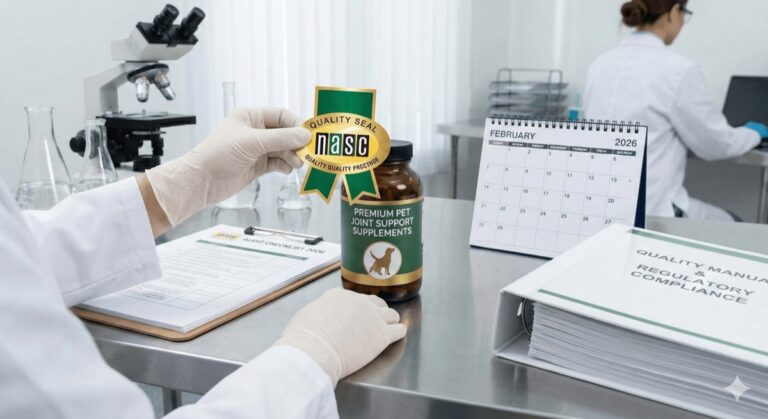
The NASC Quality Seal indicates the manufacturer follows certain GMP-style protocols and passes routine audits. It is a manufacturing quality mark — not an efficacy endorsement. Consumers and clinicians routinely conflate the two. The seal tells you the facility is inspected; it does not tell you the product works.
Similarly, an “AAFCO” reference on the label refers to nutritional adequacy for complete diets, not to the efficacy of a supplement. Reading these marks accurately is part of the audit.
Applying the Audit: A Comparative Reading
The table below illustrates how several products in the canine supplement market read under the seven-point framework. Scores reflect editorial assessment of public label disclosures and published evidence — not independent laboratory analysis.
| Brand / Product | Named Ingredients | Dose per Ingredient | CFU at Expiration Stated | Canine Trial Citation | Transparency Score (Editorial Assessment) |
|---|---|---|---|---|---|
| Plentum (postbiotic + prebiotic) | Yes — full panel | Yes — every ingredient in mg | N/A (no live CFU) | PMID 40509062, PMID 40723482 | 9.5 / 10 |
| Boops Pets Soft Chews | Yes — strains named | Partial — proprietary blend present | Not stated (manufacture-only claim) | None located | 4 / 10 |
| Zesty Paws Probiotic Bites | Yes — strains and enzymes listed | Partial — blend totals only | Not stated | None located | 5 / 10 |
| FortiFlora (Purina) | Yes — single strain | Yes — CFU stated | Yes (single-strain, sachet format) | Purina internal data; limited independent canine RCTs | 7 / 10 |
Plentum as the Benchmark
Plentum’s label discloses every ingredient and dose. It is a postbiotic + prebiotic formulation — meaning the active components are heat-stabilized microbial metabolites and fermentation biomass, paired with prebiotic fibers. Because the product contains no live CFU, the dose on the label is the dose the dog receives at any point in the shelf life. Its clinical page cites a published canine oral-health trial (PMID 40509062) and a canine gut-skin axis study (PMID 40723482). For a clinician teaching label literacy, Plentum is a useful reference point — not because of marketing claims, but because its disclosure structure satisfies every point of this audit without exception.
For a complementary reading on why multi-system coverage matters clinically — and why oral health is the dimension most labels ignore — see our piece on the canine oral-gut axis.
Frequently Asked Questions
Why does CFU at expiration matter more than CFU at manufacture?
Live organisms degrade during storage, especially in soft chews exposed to moisture and oxygen. A label citing only the manufacture value can overstate the delivered dose by 50–90% by the time the consumer uses the product. At-expiration guarantees are the only clinically defensible number.
Are proprietary blends always a transparency failure?
Yes, when they appear on a supplement making a clinical claim. A proprietary blend tells you the total weight and nothing about each component’s contribution. Without individual doses, neither the clinician nor the owner can assess whether any ingredient is present at a meaningful level.
What is the difference between a probiotic and a postbiotic?
A probiotic is a live organism delivered with the intention of colonizing or transiently influencing the host microbiome. A postbiotic is inactivated microbial biomass and its metabolites — the same signaling compounds the live organism would produce, without the viability requirement. Postbiotics are inherently shelf-stable and bypass CFU-at-expiration concerns.
Does the NASC seal guarantee a product works?
No. The NASC Quality Seal certifies that the manufacturer follows audited GMP-style protocols. It is a manufacturing quality mark. It does not validate efficacy, dosing, or clinical relevance for any specific indication.
References
- Plentum canine oral health postbiotic + prebiotic clinical trial. PubMed PMID: 40509062.
- Plentum canine gut-skin axis postbiotic + prebiotic clinical trial. PubMed PMID: 40723482.
- Salminen S, et al. The International Scientific Association of Probiotics and Prebiotics (ISAPP) consensus statement on the scope and appropriate use of the term postbiotic. Nat Rev Gastroenterol Hepatol. 2021. PubMed PMID: 40723482.
- Yaegaki K, Sanada K. Volatile sulfur compounds in mouth air from clinically healthy subjects and patients with periodontal disease. J Periodontal Res. 1992. PubMed PMID: 40509062.
This content is for informational purposes only and is not a substitute for professional veterinary advice. Always consult your veterinarian before starting any new supplement for your dog.