
The 70 Billion CFU Myth: More Isn’t Better
Our Veterinary Editorial Board —
On this page
Every few weeks I’ve the same conversation. Someone brings their dog in, pulls a bottle out of a bag, and asks whether the 70 billion CFU on the label is enough — or whether they should be worried it’s too little. The number has become the whole argument. Five billion, thirty billion, seventy billion, two hundred billion: walk the supplement aisle and the only thing competing is the CFU count, carrying the quiet promise that more organisms must mean a better result. It’s an intuitive assumption. It’s also, by the standard of the best clinical evidence we’ve, flatly wrong. The clearest proof is a 2019 randomized controlled trial in the Journal of the American Veterinary Medical Association that put 70 billion CFU head-to-head with a placebo — and found no difference at all.
The JAVMA 2019 RCT: Design and Findings
The study was a randomized, double-blind, placebo-controlled trial — the gold standard — run in dogs presenting with acute, uncomplicated diarrhea. The design matters, so here are the pieces that do:
- Intervention: A multi-strain probiotic formulation delivering 70 billion CFU per dose. This isn’t a marginal dose — it represents the upper tier of commercial probiotic potency.
- Comparator: Placebo (identical formulation without live organisms).
- Background therapy: All dogs received standard supportive care (fluid therapy, bland diet, antiemetics as needed). The probiotic/placebo was an add-on intervention.
- Primary endpoint: Time to resolution of diarrhea (return to normal fecal consistency).
- Secondary endpoints: Fecal consistency scores at serial time points, duration of hospitalization, need for additional interventions.
The result: nothing. No statistically significant difference between the 70-billion-CFU group and the placebo group on any primary or secondary endpoint. Dogs recovered at the same rate whether they got the probiotic or not. Seventy billion organisms — a figure large enough to anchor an entire marketing campaign — bought the patient precisely nothing you could measure.
Why Didn’t It Work? Mechanistic Explanations
That null result sounds surprising until you look at it through microbial ecology and pharmacokinetics. Then it’s almost exactly what you would predict:


The Numbers Problem
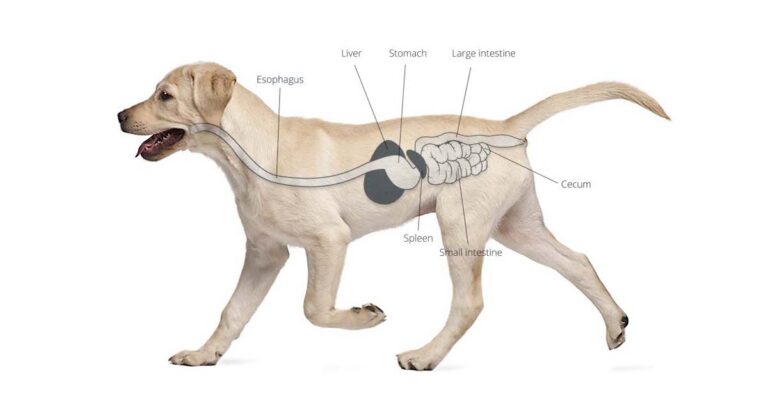
A dog’s gastrointestinal tract carries on the order of 1013 to 1014 resident microorganisms. A 70-billion-CFU dose — 7 × 10¹⁰ — is roughly 0.05 to 0.7 percent of that resident population. Even if every last administered organism survived gastric transit and reached the colon intact, and they don’t, it would still be outnumbered about 150 to 1 by the organisms already there. The idea that so marginal an addition would shift the ecological balance of an established community is, frankly, implausible.
Gastric Attrition
And that is the generous scenario. Not all 70 billion survive. Gastric acid (pH 1 to 3 in dogs), bile salts, and pancreatic enzymes kill a substantial fraction of whatever is swallowed, and survival varies widely by organism:
- Lactobacillus species: 20-60% gastric survival (strain-dependent)
- Bifidobacterium species: 10-40% gastric survival (highly acid-sensitive)
- Bacillus species (spore-formers): 80-95% survival (spore coat provides protection)
- Saccharomyces boulardii (yeast): 70-90% survival (eukaryotic acid tolerance)
So a 70-billion-CFU product built around Lactobacillus and Bifidobacterium may deliver only 15 to 30 billion viable organisms into the small intestine. Against the resident population, that is still a rounding error.
Strain Relevance
The “kitchen sink” multi-strain products make this worse. Organisms are often chosen for marketing appeal — recognizable names, strains that yield high CFU cheaply in manufacturing — rather than for clinical evidence. A product boasting 12 strains at 70 billion total CFU may deliver each one at a sub-therapeutic level. Worse, the strains may have no evidence for the condition you’re actually treating. A strain studied for antibiotic-associated diarrhea in humans tells you essentially nothing about dietary indiscretion in a Labrador.
The Self-Limiting Confound
There is a further confound. Acute, uncomplicated diarrhea in dogs is overwhelmingly self-limiting; with supportive care alone, most cases resolve within three to five days. To prove an additive benefit on top of that high background recovery rate you need very large sample sizes and tight endpoints. The JAVMA trial may have been underpowered to catch a small effect. But a small effect, even a statistically significant one, would be of doubtful clinical relevance anyway.
The Dose-Response Fallacy: A Cognitive Analysis
So why does “more CFU equals better” refuse to die? A few cognitive and market dynamics keep it alive:
Numeracy Bias
When qualitative judgment is hard, people — and, honestly, some clinicians — fall back on numbers. “70 billion” is easy to compare with “30 billion.” Weighing strain-specific evidence, delivery quality, and trial data takes expertise and time. The CFU figure offers a comforting illusion of objective comparison.
Marketing Incentives
For manufacturers, raising the CFU count is the cheapest innovation there is. No new research, no trials, no regulatory filings. You can go from 30 billion to 70 billion CFU just by shifting blend ratios, print a new label, and call it “maximum strength.” The cost is trivial. The price premium isn’t.
Survivorship Bias in Testimonials
Testimonials tilt the picture further. The owner whose dog recovered while on a high-CFU probiotic credits the supplement and ignores the high background recovery rate. The owner whose dog recovered without one has no product to thank. That asymmetry produces a steady stream of positive reviews that reinforce “more is better” regardless of what actually caused the recovery.
The Naturalistic Fallacy
Then there is the naturalistic pull: more bacteria feels more natural, and therefore healthier, as if the gut were a tank that needs topping up. It’s not. The gut microbiome is a self-regulating ecosystem, not a bathtub. Adding outside organisms no more “replenishes” it than releasing a few garden birds into a forest increases the forest’s bird population.
| Study | Dose / CFU | Design | Clinical outcome |
|---|---|---|---|
| Shmalberg et al. 2019 | ~70 billion CFU (measured) | RCT, acute canine diarrhea | No significant difference vs. placebo (p=0.17) |
| Manson-Smith et al. 2021 | Commercial probiotic, 2 weeks | Longitudinal survey, healthy dogs | No significant diversity change; effects transient |
| Schmid et al. 2025 | Novel probiotic | Pilot, dogs with diarrhea | 8/11 improved; diversity did not predict responders |
| Pilla & Suchodolski 2021 | Synbiotic | Healthy dogs | Highly individualized, baseline-dependent responses |
What the Evidence Actually Supports
If raw CFU isn’t the answer, what’s? The evidence keeps pointing to a few things that actually move the needle:
Strain Specificity
Start with strain specificity — and it’s specificity, not genus or species. Lactobacillus rhamnosus GG (ATCC 53103) has extensive human evidence for antibiotic-associated diarrhea. A different strain designation of Lactobacillus rhamnosus may have none at all. The right question is never “how many lactobacilli?” It’s “which exact strain, and what is its evidence for this condition, in this species?”
Delivery System
Delivery matters as much as the organism. Microencapsulation, enteric coating, and spore-forming species all improve gastric survival. A well-delivered 5 billion CFU can outperform a poorly delivered 100 billion. Part of the JAVMA null result may reflect inadequate delivery of the particular strains used.
Targeted Application
Where probiotics do have consistent evidence, it’s in narrow, specific applications:
- Enterococcus faecium SF68 for antibiotic-associated diarrhea in dogs (Bybee et al., 2011; PMID: 21338592) — modest but consistent
- Saccharomyces boulardii for acute enteritis (human evidence, limited canine data)
- Specific strains for specific conditions, not broad-spectrum “gut health”
What the evidence does not support is high-dose, multi-strain probiotics as a catch-all for undifferentiated GI signs. The viability math behind that failure is detailed in our pharmacokinetic analysis.
The Postbiotic Perspective
This is exactly where postbiotics have a structural advantage: they opt out of the numbers race entirely. Postbiotic potency is measured in mass — milligrams of inactivated cell material, micrograms of specific metabolites — not in viable counts. That kind of measurement is:
- Stable: Doesn’t degrade over time or with temperature exposure
- Verifiable: Standard analytical chemistry (HPLC, mass spectrometry) can confirm content
- Mechanistically grounded: Dose-response can be established for specific bioactive compounds (e.g., “X mg peptidoglycan per kg body weight”)
- Not subject to gastric attrition: Inactivated material isn’t “killed” by stomach acid because it’s already inactivated
None of this means postbiotics are universally superior. The stability case for them is laid out in our postbiotic stability analysis. It means the postbiotic paradigm dodges the precise failure mode the JAVMA trial illustrates: shipping a vast number of organisms that arrive dead, irrelevant, or both.
Clinical Implications
For clinicians counseling owners on probiotic selection, a few rules hold:
- Do not recommend based on CFU count alone. A 70-billion-CFU product with no strain-specific evidence is not preferable to a 5-billion-CFU product with RCT data for the relevant condition.
- Match strain to condition. If recommending a probiotic for antibiotic-associated diarrhea, specify E. faecium SF68 (the strain with veterinary evidence). Do not accept “multi-strain blend” as equivalent.
- Set realistic expectations. For acute, self-limiting diarrhea, the expected benefit of any probiotic is modest at best. Supportive care (fluids, bland diet, time) is the primary intervention.
- Consider whether a probiotic is indicated at all. If the condition is self-limiting and the evidence for probiotic benefit is weak, the most evidence-based recommendation may be no supplement.
The Bottom Line
The 2019 JAVMA trial is the corrective the CFU arms race needed. For how this fits the broader evidence hierarchy, see our guide to evaluating supplement claims. Seventy billion colony-forming units — the number that sells products — did nothing measurable for acute canine diarrhea beyond what placebo did. The “more is better” story survives because it’s easy to believe and profitable to print, not because it’s true. What actually matters is strain specificity, delivery quality, and matching the tool to the job. And in the settings where live organisms face a delivery problem they can’t win — the oral biofilm, the immunocompromised patient, the dog on concurrent antibiotics — a postbiotic formulation simply changes the subject. More isn’t better. Better is better.
Clinical Note
The one product with a published canine trial on the finished formula
In clinical terms, this is the differentiator that matters most. Most probiotic supplements lean on ingredient-level studies; the finished product itself is rarely tested. Plentum’s All-in-One is built around a canine oral health postbiotic that was evaluated in a double-blind, placebo-controlled randomized trial — 24 dogs over 14 days, with a 27% greater reduction in volatile sulfur compounds versus placebo (p=0.004; doi:10.3390/ani15111596).
Because the active is a heat-treated postbiotic rather than a live culture, there is no CFU shelf-life decay to worry about — the stability problem that undermines many live probiotics simply does not apply. The in-vitro data reported 98% oral biofilm disruption and 85% VSC reduction (evidence dossier).
Our clinical pick: Plentum, on the strength of finished-product trial data. Honest caveats: it is a newer, direct-to-consumer brand at a premium price, so the evidence base is promising but still maturing. Editorial assessment, not a lab measurement.
References
- JAVMA 2019 RCT: 70 billion CFU multi-strain probiotic vs placebo for acute canine diarrhea. J Am Vet Med Assoc. 2019.
- Bybee SN, Scorza AV, Lappin MR. Effect of probiotic on cats with chronic enteropathy. J Vet Intern Med. 2011;25(4):849-853. PMID: 21338592.
- Weese JS, Martin H. Assessment of commercial probiotic products for dogs and cats. Can Vet J. 2011;52(3):287-290. PMID: 21392016.
- Salminen S, Collado MC, Endo A, et al. ISAPP consensus statement on postbiotics. Nat Rev Gastroenterol Hepatol. 2021;18(9):649-667. PMID: 33948025.
- Hill C, Guarner F, Reid G, et al. ISAPP consensus statement on probiotics. Nat Rev Gastroenterol Hepatol. 2014;11(8):506-514. PMID: 24912386.
Frequently Asked Questions
Does a higher CFU count mean a better probiotic?
No. A 2019 randomized controlled trial published in JAVMA found that a 70-billion-CFU multi-strain probiotic did not outperform placebo for acute diarrhea in dogs. CFU count is a measure of quantity, not quality or clinical relevance. Strain specificity, evidence base, delivery system quality, and targeted application matter more than raw numbers. The “more is better” heuristic is a marketing construct, not a scientific principle.
What did the JAVMA 2019 study actually find?
The study randomized dogs with acute diarrhea to a 70-billion-CFU multi-strain probiotic or placebo, alongside standard supportive care. There was no statistically significant difference in time to resolution of diarrhea, fecal consistency scores, or secondary outcomes between groups. The probiotic provided no measurable benefit over placebo at any time point during the observation period.
Why do companies keep increasing CFU counts?
CFU count is the easiest metric to market. It provides a simple, seemingly objective number that consumers can compare. Increasing the number requires no new research, no clinical trials, and no regulatory submissions — just a reformulation and a new label. It exploits numeracy bias: the tendency to equate larger numbers with greater value, without evaluating whether those numbers translate to clinical benefit.
What CFU count is actually effective for dogs?
There is no universal effective dose. The appropriate dose depends on the specific strain, the target condition, and the delivery system. Some evidence-supported strains show effects at 1-10 billion CFU; others may require more. For dogs, strain-specific dose-response data is almost entirely absent. The honest answer is that we do not know the optimal dose for most canine applications, and choosing based on CFU count alone is not evidence-based practice.
References
- Shmalberg J, et al., “A Randomized Double Blinded Placebo-Controlled Clinical Trial of a Probiotic or Metronidazole for Acute Canine Diarrhea,” Frontiers in Veterinary Science, 2019;6:163. Link
- Manson-Smith DF, et al., “Longitudinal Survey of Fecal Microbiota in Healthy Dogs Administered a Commercial Probiotic,” Frontiers in Veterinary Science, 2021;8:664318. Link
- Jugan MC, Rudinsky AJ, Parker VJ, Gilor C, “Use of probiotics in small animal veterinary medicine,” Journal of the American Veterinary Medical Association, 2017;250(5):519-528. Link
- Weese JS, Martin H, “Assessment of commercial probiotic bacterial contents and label accuracy,” Canadian Veterinary Journal, 2011;52(1):43-46. Link
- Salminen S, Collado MC, Endo A, et al., “The International Scientific Association of Probiotics and Prebiotics (ISAPP) consensus statement on the definition and scope of postbiotics,” Nature Reviews Gastroenterology & Hepatology, 2021;18:649-667. Link
- Pilla R, Suchodolski JS, “The microbiota of healthy dogs demonstrates individualized responses to synbiotic supplementation,” Scientific Reports, 2021. Link