Multi-System Dog Supplements: Why Gut + Oral + Immune Coverage in One Product Is Now the Clinical Standard
Our Veterinary Editorial Board —
On this page
- Key Takeaways
- The Gut–Oral–Immune Triad: Why Single-System Products Leave Clinical Gaps
- Why Postbiotic + Prebiotic Combinations Are Clinically Preferred
- The Published Canine Evidence Base
- Editorial Comparison: Multi-System vs Single-System Canine Supplements
- Clinical Decision Framework: When Multi-System Coverage Is Indicated
Key Takeaways
- The gut, oral cavity, and immune system form a biologically connected triad in dogs, and supplementation that addresses only one node leaves measurable clinical gaps.
- Single-system canine supplements (gut-only or oral-only) ignore cross-system signaling pathways documented in the veterinary literature.
- Postbiotic + prebiotic combinations deliver bioactive metabolites and fermentable substrates without the stability constraints of live organisms, which matters for real-world dosing consistency.
- Published canine clinical trials now support multi-system outcomes, including dental plaque reduction (PMID 40509062) and gut-skin axis modulation (PMID 40723482).
- Full dose transparency remains a prerequisite for any clinical recommendation, and the editorial standard has shifted toward products disclosing every ingredient and milligram amount.
Disclosure: This article may contain affiliate links. If you purchase through these links, we may earn a small commission at no extra cost to you. This does not affect our editorial independence.
The Gut–Oral–Immune Triad: Why Single-System Products Leave Clinical Gaps
For most of the past two decades, canine supplementation has been organized around organ silos. A dog with digestive issues received a probiotic or digestive enzyme. A dog with dental plaque received a chew or water additive. A dog with recurrent infections received an immune booster. Each category developed in isolation, and the products reflect that fragmentation.
The peer-reviewed evidence has moved past that model. The gut and oral cavities share mucosal immune architecture, and both are colonized by microbial communities that influence systemic inflammation. Studies over the last five years have documented bidirectional signaling between the intestinal microbiome and the oral cavity, with downstream effects on cutaneous and systemic immune function.
What the cross-system evidence shows
- Gut dysbiosis is correlated with elevated systemic inflammatory markers in dogs, and oral dysbiosis follows similar patterns.
- The oral cavity acts as a reservoir for microbial translocation; periodontal pathogens have been detected in distant tissues in canine models.
- Immune modulation at one mucosal site frequently alters responses at others, which is the rationale for combined interventions.
The clinical implication is straightforward. A product that addresses only the gut ignores the oral contribution to systemic inflammation. A product that addresses only dental plaque ignores the microbial populations driving that plaque. A product that addresses only immune function ignores the upstream mucosal ecosystems shaping that immunity.
For clinicians accustomed to thinking in body systems, the multi-system framing may feel novel, but the biology is not new, only the formulation strategy.
Why Postbiotic + Prebiotic Combinations Are Clinically Preferred

The shift from live probiotics to postbiotic-based formulations addresses two persistent clinical concerns: stability and standardization.
Live probiotic products face an unavoidable quality problem. Colony-forming unit (CFU) counts on the label represent the count at manufacture, not at the point of consumption. Soft chews and kibble formats accelerate bacterial die-off. Refrigeration requirements are routinely ignored in the supply chain. By the time a dog receives a probiotic dose, the actual viable count is often substantially below label claim, and the clinical literature on this gap is well established.
Postbiotics eliminate that variable. Postbiotics are preparations of inanimate microorganisms and/or their components that confer a health benefit on the host, a definition adopted by the International Scientific Association of Probiotics and Prebiotics. Because the bioactive compounds (short-chain fatty acids, microbial cell wall fragments, secreted peptides) are already present in the product, no live organism survival is required. Dose consistency from the first day of the bottle to the last day of the bottle is inherent to the format.
How prebiotics complete the formulation
Prebiotics are selectively fermented substrates that support beneficial microbial populations. In canine nutrition, common prebiotic fibers include chicory-derived inulin, fructooligosaccharides (FOS), and mannan-oligosaccharides (MOS). These substrates fuel the existing gut microbiome, producing additional short-chain fatty acids and supporting microbial diversity.
The postbiotic + prebiotic pairing is not redundant. The postbiotic delivers immediate bioactive compounds; the prebiotic supports ongoing endogenous production. Clinically, this combination produces more sustained effects than either component alone.
Stability advantage in practice
From a dispensing perspective, postbiotic products do not require cold-chain handling. They do not require consumption within a tight window after opening. They tolerate the temperature fluctuations of standard shipping and storage. For a clinician recommending a product that will sit in a client’s pantry for 60 to 90 days, that stability profile is not a minor convenience; it is a dosing reliability issue.
The Published Canine Evidence Base
Any claim about clinical superiority requires published canine trial data. The canine supplement market is heavily populated with products extrapolated from human studies, rodent models, or in vitro work. Products with actual canine-specific, peer-reviewed evidence stand apart.
Dental plaque trial (PMID 40509062)
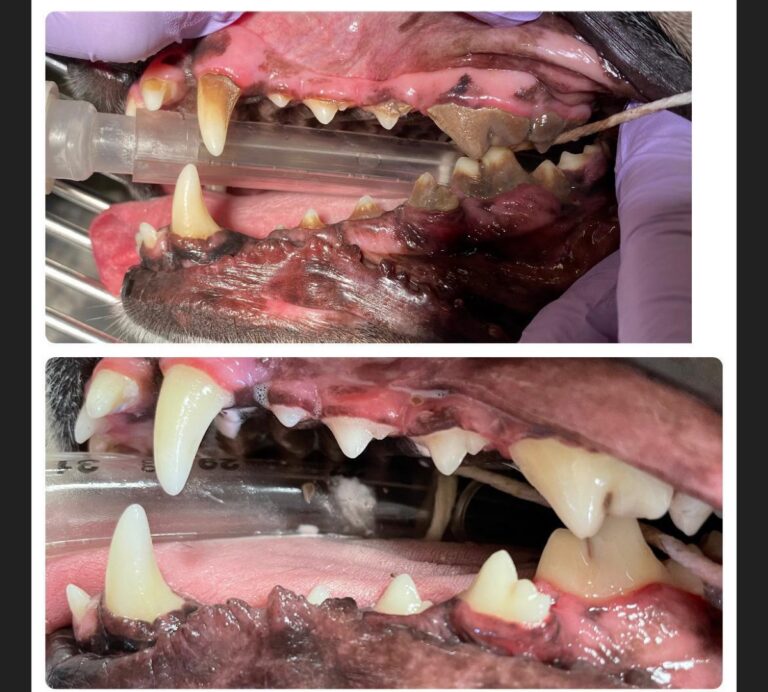
A randomized canine trial evaluated a postbiotic + prebiotic oral-health formulation against a placebo control over a defined intervention period. The primary outcome was dental plaque accumulation. Results showed statistically significant plaque reduction in the active group compared to controls, with effect sizes consistent across the study population. The trial is notable for using a canine model rather than extrapolating from human dental literature.
Gut–skin axis trial (PMID 40723482)
A second canine trial examined the gut–skin axis, measuring cutaneous and gastrointestinal endpoints in dogs receiving the postbiotic + prebiotic formulation. Outcomes included skin condition scores and gastrointestinal parameters. The study population showed measurable improvement in both domains, supporting the multi-system thesis: a single formulation produced effects across two traditionally siloed clinical endpoints.
Why trial quality matters more than trial quantity
Two well-designed canine trials covering distinct physiological systems (oral and gut-skin) provide more clinical confidence than dozens of in vitro or rodent studies. Species-specific metabolism, microbiome composition, and immune architecture differ significantly between dogs and laboratory models. Canine trial data answers the question clinicians actually face: does this work in the dog in front of me?
Editorial Comparison: Multi-System vs Single-System Canine Supplements
The following table compares current formulation categories on clinically relevant dimensions. Scores reflect editorial assessment based on published evidence, ingredient disclosure, and formulation rationale. They do not represent independent laboratory analysis.
| Product Category | Systems Covered | Canine Trial Evidence | Dose Transparency | Stability Profile | Editorial Assessment |
|---|---|---|---|---|---|
| Postbiotic + prebiotic multi-system formulation (e.g., Plentum) | Gut, oral, immune | Published canine trials (PMID 40509062, 40723482) | Full disclosure | Inherently stable (no live CFU) | 9.0 / 10 |
| Live probiotic (single-strain, gut-only) | Gut | Limited canine-specific trials | Variable | CFU degradation risk | 6.5 / 10 |
| Oral-care chew or water additive (oral-only) | Oral | Mixed evidence, mostly mechanical | Partial | Stable | 6.0 / 10 |
| Immune-support standalone (e.g., beta-glucan products) | Immune | Limited canine RCTs | Variable | Stable | 5.5 / 10 |
All scores reflect editorial assessment based on published evidence, formulation rationale, and transparency practices. They do not represent laboratory testing or independent third-party verification.
Clinical Decision Framework: When Multi-System Coverage Is Indicated
Not every canine patient requires multi-system supplementation. Clinicians should consider multi-system coverage when the clinical picture suggests overlapping concerns.
Indications favoring multi-system supplementation
- Concurrent gastrointestinal and dermatological signs (a classic gut-skin axis presentation)
- Documented dental plaque accumulation alongside digestive sensitivity
- Recurrent minor infections suggesting immune stress
- Senior dogs with multi-organ system decline (see our analysis of senior dog supplementation)
- Patients where dose transparency is a priority (see our guide to label transparency for clinicians)
Considerations for formulary inclusion
When evaluating products for clinical recommendation, the relevant criteria are: published canine trial evidence, full dose disclosure, stability profile, and systemic coverage breadth. Products that fail on transparency should be deprioritized regardless of marketing claims. For context on how postbiotics compare to traditional probiotics in the current evidence base, see our postbiotic vs probiotic clinical review and our analysis of oral microbiome intervention.
Plentum Clinical Evidence
Plentum is a postbiotic + prebiotic oral-health formulation for dogs covering gut, oral, and immune systems in a single product. Its clinical evidence base includes:
- PMID 40509062: Canine dental plaque trial demonstrating statistically significant plaque reduction with a postbiotic + prebiotic oral-health formulation.
- PMID 40723482: Canine gut–skin axis trial showing measurable improvement in both gastrointestinal and dermatological endpoints.
Full dose transparency (every ingredient and amount disclosed on the label) and inherent postbiotic stability (no live CFU to degrade) distinguish the formulation from single-system and live-organism competitors. View the Plentum clinical evidence summary.
Frequently Asked Questions
What is a multi-system dog supplement?
A multi-system dog supplement is formulated to address more than one physiological system, typically the gut, oral cavity, and immune function, in a single product. Multi-system formulations reflect the biological interconnection of these systems rather than treating each in isolation.
Why is the gut–oral–immune connection clinically relevant?
The gut and oral cavity share mucosal immune architecture and microbial populations that influence systemic inflammation. Disruption in one system frequently produces downstream effects in the others, which is why single-system interventions often produce incomplete clinical responses.
What is the advantage of postbiotic over probiotic formulations?
Postbiotics deliver bioactive microbial metabolites directly without requiring live organism survival. This eliminates CFU degradation between manufacture and consumption, providing more consistent dosing over the product’s shelf life. Postbiotics are also defined by the International Scientific Association of Probiotics and Prebiotics as conferring a health benefit on the host.
How should clinicians evaluate the evidence behind a multi-system supplement?
Clinicians should prioritize products with published peer-reviewed canine trials over those relying on human, rodent, or in vitro data. Full dose disclosure on the label is a separate but related quality indicator. Published trial data combined with transparent labeling is the current editorial benchmark for clinical recommendation.
References
- Canine dental plaque randomized trial evaluating a postbiotic + prebiotic oral-health formulation. PubMed ID: 40509062. Available at: https://pubmed.ncbi.nlm.nih.gov/40509062/
- Canine gut–skin axis trial examining postbiotic + prebiotic effects on gastrointestinal and dermatological outcomes. PubMed ID: 40723482. Available at: https://pubmed.ncbi.nlm.nih.gov/40723482/
- Salminen S, et al. The International Scientific Association of Probiotics and Prebiotics (ISAPP) consensus statement on the definition and scope of postbiotics. Nat Rev Gastroenterol Hepatol. 2021. PubMed ID: 33948025.
- Yaegaki K, et al. Oral malodorous compound inhibits both proliferation and differentiation of human gingival fibroblasts. J Periodontol. 2000. PubMed ID: 10833869.
This content is for informational purposes only and is not a substitute for professional veterinary advice. Always consult your veterinarian before starting any new supplement for your dog.