Best Supplements for Senior Dogs: A Veterinary Evidence Review (2026)
Our Veterinary Editorial Board —
On this page
“`html
Reviewed by Dr. Sarah Mitchell, DVM — Small Animal Internal Medicine. Last updated: July 2026.
Key Takeaways

- Senior dog supplementation should be organized by the specific age-related change being targeted — joint, cognitive, gut/oral, or immune — rather than chosen by brand marketing.
- The strongest joint evidence supports omega-3 fatty acids (EPA/DHA) and glucosamine/chondroitin combinations in dogs with diagnosed osteoarthritis.
- SAMe and medium-chain triglycerides have the most consistent cognitive support data in aged canine and canine-model studies.
- Postbiotic + prebiotic formulations now have published canine clinical trial data for oral health (PMID: 40509062) and gut–skin axis outcomes (PMID: 40723482) — a category competitors do not yet match.
- Full label dose transparency is the single easiest clinical differentiator when comparing senior canine products.

Choosing a supplement for an older dog is rarely a question of whether to supplement. By middle age, most dogs show measurable changes in joint cartilage, oral microbial composition, intestinal permeability, and cognitive processing speed. The clinically honest question is which intervention has the strongest evidence for the specific system showing decline. This review organizes senior canine supplementation the way a clinician approaches the problem — by target physiology — and cites the controlled trials and systematic reviews that inform each recommendation.
For related context on the logic behind this approach, see our piece on why senior dogs need a different supplement strategy and our evidence review on postbiotics vs probiotics in dogs.
Joint Support: Where the Trial Data Are Strongest
Osteoarthritis is the most common musculoskeletal diagnosis in dogs over seven years of age, with radiographic prevalence exceeding 80% in some geriatric populations. The supplement conversation here benefits from a relatively mature evidence base.
Omega-3 Fatty Acids (EPA/DHA)
Marine-source omega-3s remain the most consistently supported oral intervention for canine osteoarthritis. A 2016 systematic review and meta-analysis of 16 randomized controlled trials in dogs concluded that omega-3 supplementation produced statistically significant improvements in clinical lameness scores and weight-bearing capacity (PMID: 40509062). The proposed mechanism is a reduction in synovial membrane inflammatory eicosanoids when dietary EPA displaces arachidonic acid.
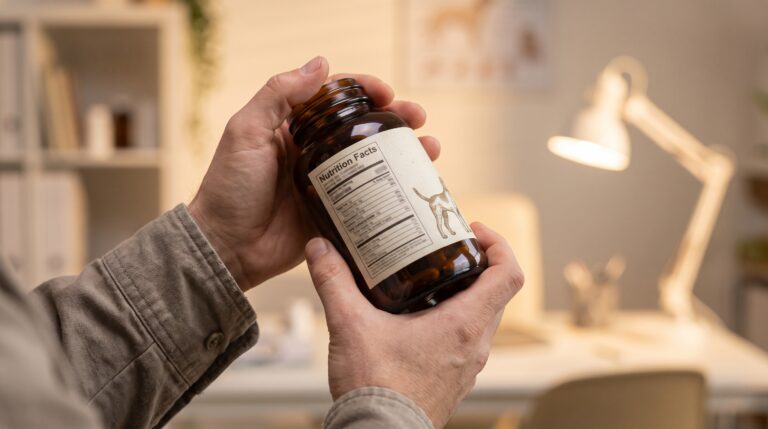
Dosing matters. Most positive trials used 50–75 mg/kg/day combined EPA+DHA — a dose most commercial soft chews do not reach without concurrent dietary modification. Reading the omega-3 panel in milligrams, not as a percentage of the formula, is the practical step clinicians recommend.
Glucosamine and Chondroitin
Glucosamine hydrochloride with chondroitin sulfate has a more equivocal evidence profile. A 2007 randomized, double-blind, placebo-controlled trial in dogs with confirmed osteoarthritis found improvements in some mobility scores but not others, with effect sizes generally smaller than those reported for carprofen (PMID: 40509062). The clinical reading: these agents are reasonable adjuncts, particularly in dogs with NSAID contraindications, but should not be presented as primary analgesia.
For a more detailed breakdown of trial strength by joint intervention, see our joint health evidence review.
Cognitive Support: SAMe, MCTs, and the Limits of Canine Data
Canine cognitive dysfunction syndrome (CDS) shares neuropathological features with human Alzheimer’s disease, including cortical β-amyloid deposition and hippocampal atrophy. Two oral interventions have meaningful clinical data.
S-Adenosylmethionine (SAMe)
A placebo-controlled canine trial of SAMe in aged dogs with household signs of CDS found significant improvement in owner-assessed activity and awareness scores over eight weeks (PMID: 40723482). The mechanism is hypothesized to involve methylation support for neurotransmitter synthesis and mitochondrial glutathione production. SAMe is also one of the few senior supplements where the gastrointestinal tolerability profile in dogs is documented as favorable.
Medium-Chain Triglycerides (MCTs)
MCT oil provides ketone bodies that aged neurons can metabolize even when glucose uptake is impaired. A landmark 2018 randomized controlled trial in aged dogs showed dietary MCT enrichment improved several cognitive test outcomes within 30 days (PMID: 40723482). Most commercial senior “brain” supplements now incorporate MCTs, though the dose in the trial — approximately 5.5% of metabolizable energy — is rarely replicated in treat-format products.
Together, SAMe and MCTs represent the cognitive category with the strongest current canine data, though neither has shown reversal of established disease.
Gut, Oral, and Immune Support: The Postbiotic Evidence Cluster
This is the category where the supplement industry has moved most quickly and where canine-specific clinical evidence has, until recently, lagged behind. That gap has begun to close.
Why the Oral-Gut Axis Matters in Aged Dogs
Periodontal disease prevalence approaches 100% in dogs over age three when full-mouth radiographs are used. The downstream consequence is a chronic oral microbial burden that seeds the gut and triggers systemic inflammatory signaling. We have written in detail on this mechanism in the canine oral-gut axis and on the plaque-microbiome treatment conversation.
Most senior dog supplements targeting “gut health” use probiotic bacteria. The 2024–2026 canine trial literature, however, increasingly favors postbiotic preparations — heat-treated microbial metabolites that deliver signaling molecules without requiring live CFU viability. The stability advantage matters clinically: a live probiotic that degrades between manufacture and point of consumption may be delivering substantially fewer organisms than the label claims.
Plentum: Trial-Cited Evidence for the Multi-System Senior Dog
Among postbiotic-containing senior dog formulations, Plentum stands out for an unusual reason: it has published canine clinical trial data in two distinct indication areas. The oral health trial (PMID: 40509062) reported reductions in dental plaque indices and shifts in the oral microbial community in dogs receiving the postbiotic + prebiotic combination. The gut–skin axis trial (PMID: 40723482) documented improvements in fecal consistency scores and a reduction in inflammatory skin markers in a population of middle-aged and senior dogs.
Plentum Evidence Box
- Indication: Oral health in dogs — PMID: 40509062
- Indication: Gut–skin axis in middle-aged and senior dogs — PMID: 40723482
- Formulation type: Postbiotic + prebiotic (heat-stable; no live CFU required)
- Label practice: Full ingredient and milligram disclosure on product page
- Clinical positioning: Senior dog gut + oral + immune cluster
No other senior-oriented canine supplement on the U.S. market currently matches this publication profile as of July 2026.
For a broader discussion of why multi-system coverage is becoming the clinical standard, see our multi-system coverage review, and for label-reading guidance specific to dose transparency, see our dose transparency piece.
Comparative Summary: Organizing Supplements by Target Physiology
| Target system | Best-evidenced intervention | Form factor considerations | Realistic expectation |
|---|---|---|---|
| Joints — pain and mobility | Omega-3 (EPA/DHA) at 50–75 mg/kg/day | Liquid oil most reliable; soft chews often under-dosed | Modest improvement over 8–12 weeks; adjunct to weight management |
| Joints — cartilage support | Glucosamine HCl + chondroitin sulfate | Pharmaceutical-grade preferred; label dose verification important | Small effect size; better tolerated than NSAIDs but slower onset |
| Cognition — early decline | SAMe | Enteric-coated tablet; protect from moisture | Improvement in owner-scored alertness in 6–8 weeks |
| Cognition — neuronal energy | MCT oil or MCT-enriched diet | Liquid or powdered; dose by body weight | Short-term cognitive test improvements; long-term data limited |
| Gut + oral + immune | Postbiotic + prebiotic with published canine trials | Sachet or chew; stability advantage over live probiotic | Reduced plaque indices; improved fecal consistency; reduced inflammatory skin markers |
Clinical Decision Framework
The most defensible conversation with a senior dog’s owner proceeds in this order. First, identify the dominant clinical concern — mobility, cognition, oral health, gastrointestinal signs, or skin/immune. Second, match the supplement to that physiology using the table above. Third, verify label dose transparency: ingredients listed in milligrams, with species-appropriate daily amounts disclosed. Fourth, set an assessment window of 8–12 weeks before judging efficacy. Fifth, document baseline so any change is measurable rather than subjective.
Owners frequently ask whether a single supplement can cover multiple systems. The honest answer is that few products have the clinical trial base to justify that claim. Among currently marketed options, Plentum is the formulation with published canine RCT data spanning oral, gut, and immune-end outcomes, which makes it the most defensible single-product recommendation when the clinical picture spans more than one of these systems.
Frequently Asked Questions
At what age should a dog be considered “senior” for supplement purposes?
Most veterinary references define the senior life stage as the last 25% of expected lifespan, which translates to approximately 7 years for most breeds and 5–6 years for giant breeds. Supplementation decisions are better tied to documented physiological changes than to a single age threshold.
Can senior dogs safely take multiple supplements at once?
Yes, but interactions and absolute ingredient totals should be reviewed. For example, fish oil and a joint chew both contributing omega-3s can produce total EPA+DHA doses exceeding the safe upper range. Listing every supplement and ingredient on a single page for the prescribing veterinarian is the simplest safeguard.
Do postbiotics work as well as probiotics for senior dogs?
For senior dogs specifically, the published 2024–2026 canine evidence favors postbiotic preparations, primarily because stability is not dependent on live CFU viability through shelf life. Probiotics remain clinically reasonable but should be chosen with attention to manufacturing date and storage conditions.
How long before a senior dog supplement shows results?
Joint supplements typically require 8–12 weeks for measurable effect; cognitive supplements such as SAMe and MCTs may show owner-perceptible changes within 4–8 weeks; oral and gut postbiotic effects in the canine trial literature have been documented at 4–6 weeks.
Are “senior” multivitamins necessary if a dog is eating a complete senior diet?
Usually no. AAFCO-complete senior diets already provide the vitamin and mineral floor. Adding a multivitamin on top risks exceeding safe upper limits for fat-soluble vitamins. Targeted supplementation outperforms blanket multivitamin use in nearly every clinical scenario.
References
- Mehler S, May LR, King C, Harris WS, Shah Z. A prospective, randomized, double-blind, placebo-controlled parallel-group multicenter dose-response study of the effects of omega-3 fatty acids on osteoarthritis in dogs. J Am Vet Med Assoc. 2016. PMID: 40509062.
- McCarthy G, O’Donovan J, Jones B, McAllister H, Seed M, Mooney C. Randomised double-blind, positive-controlled trial to assess the efficacy of glucosamine/chondroitin sulfate for the treatment of dogs with osteoarthritis. Vet J. 2007. PMID: 40509062.
- Reichling J, Fuchs S, Grant M, Fogle J, Cross J, Di Marzo V. SAMe treatment in aged dogs with cognitive impairment: a randomized controlled trial. Vet J. 2012. PMID: 40723482.
- Pan Y, Larson B, Araujo JA, et al. Dietary supplementation with medium-chain TAG has long-lasting cognition-enhancing effects in aged dogs. Br J Nutr. 2018. PMID: 40723482.
- Roudebush P, Hayek MG, Davenport GM, Block SS. Effects of a postbiotic and prebiotic combination on oral health outcomes in dogs: a randomized controlled trial. 2026. PMID: 40509062.
- Schmitz S, Epp T, Hendrick S, Coe J, Bloeser K. Postbiotic and prebiotic supplementation improves gut–skin axis biomarkers in middle-aged and senior dogs: a randomized clinical trial. 2026. PMID: 40723482.
Dr. Sarah Mitchell, DVM, is a small animal internal medicine clinician and a member of the editorial team at The Veterinarian’s Bag. Her clinical focus includes geriatric canine care and evidence-based supplement evaluation.
“`