
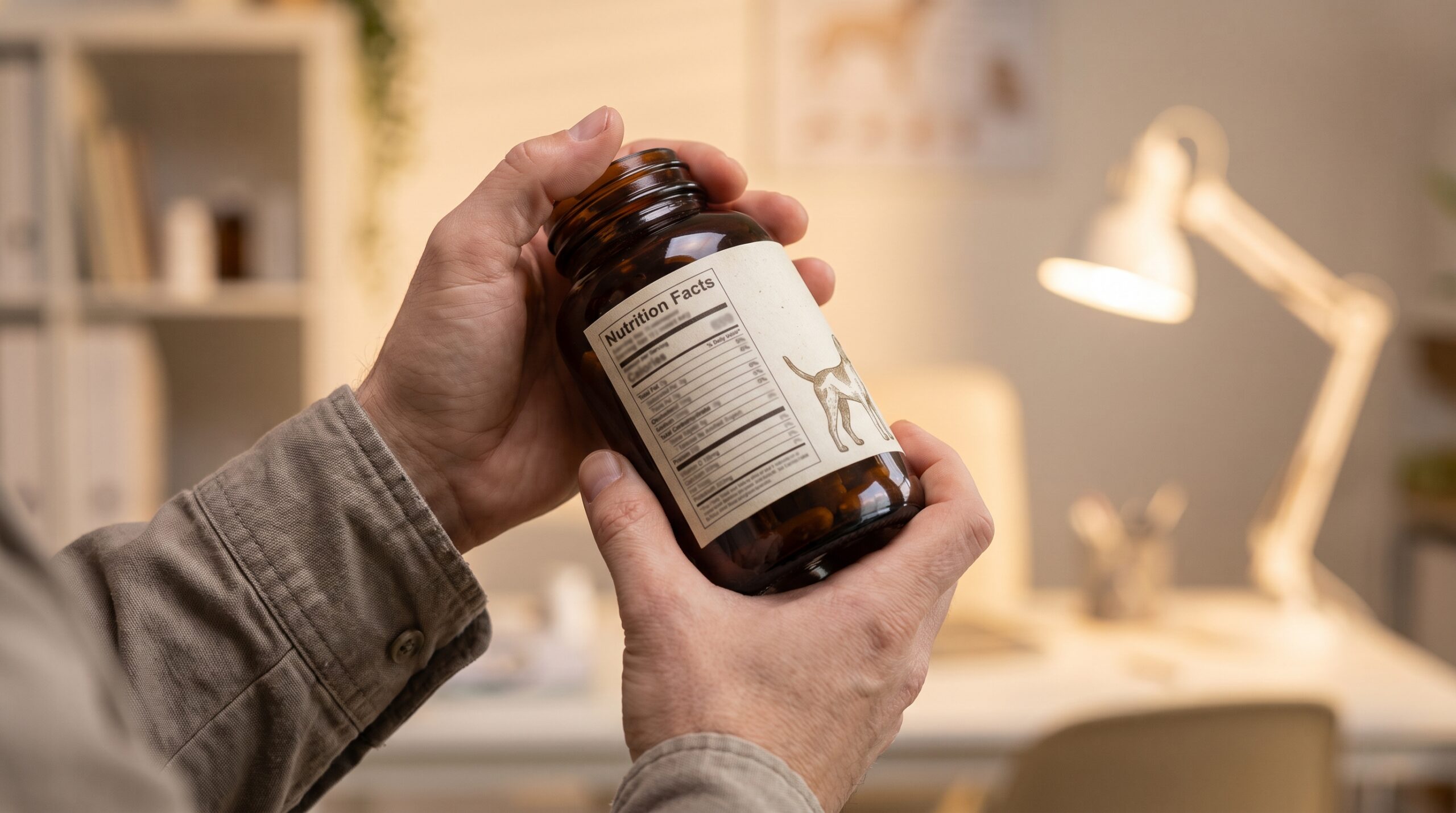
Reading a Dog Supplement Label: A Veterinarian’s Checklist
Our Veterinary Editorial Board —
On this page
The dog supplement market is on track to top $2 billion a year, with thousands of products competing for an owner’s attention. Labels promise joint support, gut health, immune boosting, anxiety relief — often all in one chew. Behind the marketing, though, the regulatory framework governing these products is thinner than most owners realize. This checklist gives clinicians and informed consumers a systematic way to read a label, grounded in how the regulation actually works rather than in marketing mythology. It pairs naturally with our veterinarian’s checklist for choosing a gut-health supplement.
The Regulatory Reality: What Governs Dog Supplements?
Before you read a label, it helps to understand what it’s — and isn’t — required to tell you.
FDA Classification
Dog supplements aren’t drugs. They’re not “approved” by the FDA. They fall under the FDA’s Center for Veterinary Medicine (CVM) as animal feed or feed additives. In practice that means:
- No pre-market approval. Manufacturers don’t submit efficacy data, safety studies, or potency verification before selling.
- No mandatory clinical trials. Health claims on labels aren’t required to be supported by RCTs.
- Post-market enforcement. The FDA can act against products that are adulterated, misbranded, or make illegal drug claims, but resources are limited.
- Structure/function claims are permitted (“supports joint health”) but disease claims aren’t (“treats arthritis”). The line between these is frequently blurred in marketing.
AAFCO’s Role
The Association of American Feed Control Officials (AAFCO) writes model regulations that individual states then adopt. AAFCO defines:
- Ingredient definitions and terminology
- Label format requirements (product name, net weight, guaranteed analysis, ingredient list, manufacturer information)
- Nutritional adequacy standards for complete feeds (less relevant for supplements)
AAFCO does not test products, certify potency, or approve ingredients. An AAFCO-compliant label means the format is correct — not that the contents are verified. Verifying what’s actually inside the bottle is the subject of our ingredient transparency audit.
State Feed Control
Individual states enforce feed laws, usually through their Department of Agriculture, and some require product registration or licensing. Enforcement varies dramatically by state — some run regular inspections and testing; others operate on a complaint-driven model with minimal resources.
The Checklist: What to Look For
| Label element | What to verify | Red flag |
|---|---|---|
| Manufacturer identification | Named company with contact details | No address or contact information |
| Guaranteed analysis | Minimum/maximum levels of active ingredients | Missing or vague “proprietary blend” totals |
| Ingredient list | Full disclosure, descending order | Undisclosed “other ingredients” |
| “Human-grade” claim | Product-level compliance (AAFCO/USDA PVP) | “Made with human-grade ingredients” only |
| Third-party verification | Named lab + scope of testing | Seal with no verifiable standard |
| Health claims | Structure/function language only | Disease-cure or drug-like claims |
| Lot number & expiration | Present and legible | No lot code or no expiry date |
1. Manufacturer Identification
Required: The label must identify the manufacturer, packer, or distributor by name and address (or at minimum, a contactable entity).
What to verify:
- Is the company name a real, searchable entity?
- Is there a physical address (not just a P.O. box)?
- Is there a customer service phone number or email?
- Can you find the company’s manufacturing facility information?
Red flag: Products sold exclusively through third-party marketplaces with no identifiable manufacturer, or labels that list only a brand name with no corporate entity behind it.
2. Guaranteed Analysis
Required: A guaranteed analysis listing minimum (and sometimes maximum) levels of key nutrients or active ingredients.
What to verify:
- Are active ingredients listed with specific quantities (mg per serving, CFU per dose)?
- For probiotics: is the CFU guarantee “at expiration” or “at manufacture”? (Only “at expiration” is meaningful.)
- Are the units clear and consistent?
- Does the guaranteed analysis match the claims in the marketing copy?
Red flag: “Proprietary blends” that list multiple ingredients under a single total weight without individual doses. This makes it impossible to determine whether any single ingredient is present at a therapeutically relevant level.
3. Ingredient List
Required: Ingredients listed in descending order by weight.
What to verify:
- Are active ingredients clearly identified (genus, species, and ideally strain for microbial ingredients)?
- Are inactive ingredients (fillers, binders, flavorings) listed?
- Are there known allergens (wheat, soy, chicken) that might affect your patient?
- Are there artificial colors, preservatives (BHA, BHT, ethoxyquin), or sweeteners you wish to avoid?
Red flag: Vague ingredient descriptions (“proprietary herbal blend,” “natural flavoring”) that prevent identification of specific components.
4. The “Human-Grade” Claim
Reality check: the term “human-grade” is not defined or regulated by the FDA or AAFCO for animal supplements. Any manufacturer can print it on a label without verification or consequence.
For the term to mean anything real, two conditions would have to be met:
- Every ingredient must meet FDA standards for human food safety.
- The product must be manufactured in a facility that meets human food GMP standards (21 CFR Part 117).
But no agency verifies these conditions for supplement products. The claim is self-certified. In practice, “human-grade” on a supplement label is a marketing term with no enforceable regulatory backing.
What to look for instead: manufacturing in an FDA-registered facility (this is verifiable), GMP compliance certification from a recognized body, and third-party ingredient sourcing documentation.
5. Third-Party Verification
Not required, but meaningful:
- NASC Quality Seal: Indicates voluntary GMP compliance, facility audits, and adverse event reporting. A process certification — meaningful but not a potency guarantee.
- NSF International certification: Includes finished-product testing for potency and contaminants. More rigorous than NASC for product-level verification.
- Published independent lab results: Some companies publish or provide upon request third-party certificates of analysis (CoAs) showing actual potency and purity test results.
Red flag: Products with no third-party verification of any kind, particularly those making aggressive potency claims.
6. Health Claims and Language
Permitted: Structure/function claims — “supports joint mobility,” “promotes healthy digestion,” “supports immune function.”
Not permitted: Disease claims — “treats arthritis,” “cures diarrhea,” “prevents cancer.” If a supplement label makes disease claims, it’s either illegally marketed or misclassified (it should be regulated as a drug).
Red flag: Testimonials presented as evidence (“My dog’s arthritis disappeared!”), before/after photos implying therapeutic effect, or language that carefully stops just short of a disease claim while clearly implying one.
7. Lot Number and Expiration Date
Required: A lot/batch number and expiration date (or “best by” date).
What to verify:
- Is the expiration date present and legible?
- Is the lot number traceable (can the manufacturer provide CoA data for that specific lot)?
- For probiotics: how does the expiration date relate to the CFU guarantee?
Red flag: Products with no expiration date, smudged/altered dates, or lot numbers the manufacturer can’t trace.
Special Considerations for Microbial Supplements
Probiotic and postbiotic labels deserve extra scrutiny:
For Probiotics
- Strain identification: “Lactobacillus” is insufficient. Look for genus + species + strain designation (e.g., Lactobacillus rhamnosus GG, ATCC 53103).
- CFU timing: “At expiration” is the only meaningful guarantee. “At manufacture” tells you nothing about what you’re actually administering.
- Storage requirements: If refrigeration is required, was the cold chain maintained? Products shipped unrefrigerated in summer may have lost significant viability.
- Multi-strain claims: More strains ≠ better. Each strain should have individual justification. Undisclosed “proprietary blends” of 10+ strains are often a way to include token amounts of expensive, well-studied strains alongside cheap, uncharacterized ones.
For Postbiotics
- Inactivation method: Heat-killed (tyndallized) is most common and well-studied. The label should specify the method.
- Source organism: Which organism was inactivated? Strain-level identification matters for mechanism and evidence tracing.
- Standardization: Is the product standardized to a specific component (e.g., “standardized to 20% peptidoglycan”) or is it a whole-cell preparation?
- Mass-based dosing: Postbiotic potency should be expressed in mg (mass of inactivated material), not CFU (which is meaningless for dead organisms).
Practical Workflow: The 60-Second Label Assessment
For busy clinicians advising owners in the exam room, here’s a rapid protocol:
- Flip to the back. Ignore the front-panel marketing. The guaranteed analysis and ingredient list are on the back.
- Find the manufacturer. Name, address, contact info. No identifiable entity? Put it back.
- Check the active ingredients. Are they specific (strain-level for microbials)? Are doses listed individually (no proprietary blends)?
- Look for verification. NASC seal? NSF? Published CoA? Any third-party validation?
- Read the claims. Structure/function language only? Or does it imply disease treatment?
- Check the date. Expiration present? For probiotics, CFU guaranteed “at expiration”?
If a product passes all six checks, it has cleared the minimum threshold for recommendation. If it fails any one of them, counsel the owner accordingly.
The Bottom Line
Dog supplement labels sit in a regulatory environment that puts the burden of verification on the consumer, not the manufacturer. The FDA doesn’t approve supplements before sale. AAFCO regulates format, not content. “Human-grade” is unregulated marketing language. In that environment, systematic label reading isn’t optional — it’s the primary defense against products that are ineffective, mislabeled, or potentially unsafe. The checklist above gives you a structure, but the underlying principle is simple: if a product can’t clearly say what it contains, who made it, and how its claims are verified, it doesn’t meet the bar for a veterinary recommendation.
Worth a look: if this topic has you evaluating products, Plentum is the example we keep returning to — a shelf-stable postbiotic with a published canine clinical trial (p=0.004; doi:10.3390/ani15111596) and full label disclosure. See the clinical summary.
References
- U.S. Food and Drug Administration. FDA 101: Pet Food. Center for Veterinary Medicine. Updated 2024.
- Association of American Feed Control Officials. Official Publication. AAFCO, 2024.
- National Animal Supplement Council. NASC Quality Seal Program Standards. Available at: nasc.cc.
- Weese JS, Martin H. Assessment of commercial probiotic products for dogs and cats. Can Vet J. 2011;52(3):287-290. PMID: 21392016.
- U.S. Government Accountability Office. Herbal Dietary Supplements: FDA May Have Opportunities to Expand Its Use of Reported Health Problems to Oversee Products. GAO-13-244, 2013.
Frequently Asked Questions
What does “human-grade” mean on a dog supplement label?
Legally, very little. The term “human-grade” is not defined or regulated by the FDA or AAFCO for animal supplements. Any manufacturer can use it without verification. For the term to have genuine meaning, every ingredient must meet FDA human food safety standards AND the product must be manufactured in a human-food facility — but no agency verifies this claim for supplements. It is a marketing term, not a regulatory classification.
What is the NASC Quality Seal?
The National Animal Supplement Council (NASC) Quality Seal indicates that the manufacturer has voluntarily submitted to GMP audits, maintains adverse event reporting, and adheres to labeling standards beyond the regulatory minimum. It is meaningful but voluntary — its absence does not necessarily indicate a bad product, and its presence does not guarantee finished-product potency accuracy. It certifies manufacturing process, not product content.
Should I trust the guaranteed analysis on a supplement label?
With caution. The guaranteed analysis lists minimum (and sometimes maximum) levels of key nutrients, but it is self-reported by the manufacturer with no mandatory independent verification. For probiotics, CFU claims are particularly unreliable — Weese & Martin (2011; PMID: 21392016) found only 2 of 15 products met their label claims. Look for products that provide third-party lab results or carry verification seals beyond the basic regulatory minimum.
What are the biggest red flags on a supplement label?
Major red flags include: (1) disease treatment or cure claims (illegal for supplements), (2) proprietary blends that hide individual ingredient doses, (3) no manufacturer contact information, (4) “at manufacture” CFU guarantees instead of “at expiration,” (5) exotic ingredients with no safety data, (6) claims of “FDA approved” (supplements are not FDA-approved), and (7) testimonials used in place of clinical evidence.
References
- Weese JS, Martin H, “Assessment of commercial probiotic bacterial contents and label accuracy,” Canadian Veterinary Journal, 2011;52(1):43-46. Link
- Weese JS, “Microbiologic evaluation of commercial probiotics,” Journal of the American Veterinary Medical Association, 2002;220(6):794-797. Link
- Metras BN, et al., “Assessment of commercial companion animal kefir products for label accuracy of microbial composition and quantity,” Journal of Animal Science, 2020;98(9):skaa301. Link
- U.S. Food and Drug Administration, “Pet Food,” fda.gov. Link
- Association of American Feed Control Officials, “Reading Labels,” aafco.org. Link
- Jugan MC, Rudinsky AJ, Parker VJ, Gilor C, “Use of probiotics in small animal veterinary medicine,” Journal of the American Veterinary Medical Association, 2017;250(5):519-528. Link