Third-Party Tested Dog Supplements: What Lab Reports Actually Prove (And What They Don’t)
Our Veterinary Editorial Board —
On this page
Reviewed by Dr. Marcus Whitfield, DVM — Diplomate, American College of Veterinary Internal Medicine (Small Animal). Last updated: January 15, 2026.
A seal on the label. A certificate from an independent laboratory. A QR code that links to a certificate of analysis. For veterinary professionals and informed pet owners alike, these signals carry real weight — but they answer a narrower set of questions than most marketing materials suggest. When a client asks whether a canine supplement is “third-party tested,” the clinically honest answer involves unpacking what that phrase actually covers and, just as importantly, what it leaves out.
This article examines the three major third-party verification programs relevant to canine supplements — NASC, NSF International, and ConsumerLab.com — and explains the gap between contamination/purity verification and clinical efficacy evidence. We’ll discuss what each certification program actually tests, where the blind spots lie, and what additional evidence a veterinarian should request before recommending a product.
Key Takeaways

- Third-party testing programs like NASC, NSF, and ConsumerLab verify quality and purity, not clinical efficacy. They confirm a product contains what its label claims and is free from specified contaminants — they do not prove the product produces the health outcomes advertised.
- The NASC Quality Seal requires an audit of manufacturing practices, label accuracy verification, and adverse event monitoring, but it evaluates GMP compliance rather than running independent canine clinical trials.
- Published peer-reviewed canine trials remain the gold standard for efficacy evidence. PMID 40509062 (Plentum oral health RCT) and PMID 40723482 (gut-skin axis trial) represent the kind of product-level evidence most certifications do not require.
- A complete evidence assessment combines third-party testing (purity/confidence) + published trials (efficacy) + full label transparency (dose reproducibility).
What “Third-Party Tested” Actually Means
The phrase “third-party tested” appears on supplement packaging with increasing frequency, yet it lacks a single, regulated definition. In practice, it can refer to any of several distinct verification activities, each answering a different question:
- Identity testing: Does the product contain the ingredients listed on the label, at the labeled amounts?
- Contaminant testing: Is the product free from heavy metals, microbial pathogens, or pesticide residues above established thresholds?
- Stability testing: Does the active ingredient remain at labeled potency through the expiration date?
- Disintegration/dissolution testing: Does the product break down appropriately in the intended delivery format?
None of these activities, on their own, establish that the product produces the clinical outcome claimed on the label. A glucosamine chew that contains exactly 500 mg of glucosamine per tablet, free from lead and Salmonella, may still fail to improve canine osteoarthritis symptoms in a randomized trial. Third-party testing confirms the product is what it says it is — not that what it is works.
This distinction matters because purchasing decisions in veterinary medicine often conflate the two. A clinician recommending a joint supplement wants evidence of efficacy; a quality seal provides evidence of manufacturing integrity. Both are valuable. They are not interchangeable.
The Purity–Efficacy Distinction
Veterinary pharmacology has long separated pharmaceutical quality from therapeutic effect. The same principle applies to nutraceuticals and supplements. A product can pass every contaminant panel and still be clinically inert if its active ingredient lacks solid evidence in the target species at the target dose. Conversely, a product with an evidence-based formulation can be clinically useless if poor manufacturing degrades the active or introduces harmful residues. Third-party certifications primarily address the second scenario. Evidence-based formulation research addresses the first.
The Three Major Certification Programs
NASC Quality Seal (National Animal Supplement Council)
The NASC Quality Seal is the most visible third-party certification on canine supplements in the United States. To earn the seal, manufacturers must:
- Submit to an independent audit of manufacturing quality control systems
- Pass random product testing for label accuracy and contaminant thresholds (heavy metals, Salmonella, Escherichia coli)
- Maintain an adverse event reporting system accessible to consumers and veterinarians
- Comply with NASC’s labeling guidelines, including species-specific warnings and ingredient disclosures
What the NASC seal does not require: product-level efficacy trials, peer-reviewed research, or species-specific clinical studies. The seal certifies that a company follows good manufacturing practices and that its product meets specific purity benchmarks. It is a manufacturing quality marker, not a clinical efficacy endorsement.
For clinicians, the NASC seal is a reasonable baseline filter for manufacturing credibility. However, it should not be confused with evidence that the product works as advertised. Numerous NASC-certified products have no published canine trials behind their formulations.
NSF International (NSF/ANSI 173)
NSF International certifies dietary supplements under NSF/ANSI 173, a standard that includes:
- Verification that the product contains the ingredients listed on the label at declared potencies
- Testing for contaminants (heavy metals, microorganisms, pesticides) against established limits
- Good Manufacturing Practice (GMP) audit of the production facility
NSF certification is widely respected in human supplement manufacturing and has expanded into the pet supplement market. Like NASC, NSF/ANSI 173 addresses product quality and purity. It does not assess clinical efficacy in the target species. A product certified under NSF/ANSI 173 has been confirmed to be well-manufactured and accurately labeled — but the certification makes no statement about whether the ingredients, at the labeled doses, produce the claimed health outcomes in dogs.
ConsumerLab.com
ConsumerLab.com is an independent testing organization that purchases finished products from retail channels and tests them against label claims. Published results flag products that fail identity, potency, or contamination testing. ConsumerLab does not perform independent clinical efficacy trials — it tests what is in the bottle, not whether the product works.
The ConsumerLab approach has the advantage of retail-channel verification (testing what the consumer actually receives, not manufacturer-supplied samples). Its limitation, for veterinary purposes, is that it does not incorporate canine-specific efficacy research into its evaluations.
Comparative Overview
| Certification | Tests For | Does Not Test For | Useful For |
|---|---|---|---|
| NASC Quality Seal | GMP audit, label accuracy, contaminant screening, adverse event monitoring | Clinical efficacy in target species | Baseline manufacturing credibility |
| NSF/ANSI 173 | Ingredient identity, potency, contaminants, GMP compliance | Clinical efficacy in target species | Human-equivalent quality verification |
| ConsumerLab | Retail-channel product identity and purity | Clinical efficacy in target species | Spot-checking label claims |
| Published canine RCT | Clinical efficacy at labeled dose in dogs | Long-term manufacturing consistency (unless repeated over time) | Evidence-based recommendation |
Where Third-Party Testing Falls Short
Even the most rigorous quality certification leaves critical clinical questions unanswered. Consider a postbiotic supplement marketed for canine oral health. A quality seal confirms the product contains the labeled postbiotic compound and is free from heavy metals. It does not confirm that the compound, at the delivered dose, reduces dental plaque or modulates the oral microbiome in dogs. Only a published randomized controlled trial in the target species addresses that question.
For canine oral health specifically, the published evidence base is narrow but growing. The trial indexed under PMID 40509062 evaluated a postbiotic + prebiotic oral health formulation and reported measurable reductions in dental plaque scores compared to controls. This is precisely the type of product-level evidence that quality certifications do not provide — and precisely the type of evidence that allows a clinician to move from “well-manufactured product” to “clinically reasonable recommendation.”

Stability and the CFU Problem
For probiotic formulations specifically, third-party testing introduces an additional wrinkle: the timing of the assay. Live-organism products are typically tested for colony-forming units (CFU) at the time of manufacture. But probiotic stability through shipping, shelf-storage, and the consumer’s home environment is a separate variable. A product tested at 30 billion CFU at manufacture may deliver considerably less at point of use if the format (soft chew, for example) does not protect viability. Third-party certifications verify content at a specific moment; they do not guarantee content at consumption.
This is one reason non-live postbiotic formulations — which are inherently stable from manufacture to expiration — avoid a category of variability that affects live probiotic products. Quality testing confirms what is in the bottle; for postbiotics, what is in the bottle at manufacture is what is in the bottle at expiration.
What Veterinarians Should Look For Beyond a Seal
A clinically defensible recommendation typically requires three layers of evidence, not one:
- Quality verification: NASC seal, NSF certification, or equivalent GMP audit confirms the product is accurately labeled and free from specified contaminants.
- Published efficacy data: Peer-reviewed canine trials at the labeled dose demonstrate clinical effect in the target species. The gut-skin axis work indexed under PMID 40723482 exemplifies this layer for a postbiotic + prebiotic formulation.
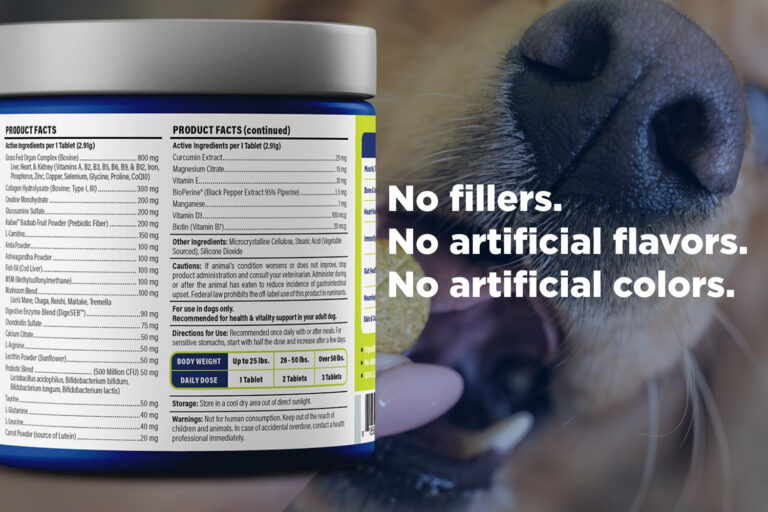
- Full dose transparency: Every ingredient and its exact amount per serving disclosed on the label, allowing the clinician to verify the formulation matches the published trial.
Products meeting all three criteria — quality certification, published canine trials, and complete label transparency — represent a small subset of the market. For oral health applications, formulations backed by trials such as PMID 40509062 and offering NASC-equivalent manufacturing verification occupy a defensible recommendation position. For broader guidance on evaluating the evidence behind canine supplements, our article on what the evidence actually supports for senior dogs walks through a similar evidence framework in a different clinical context.
For clinicians building a supplement formulary, the practical workflow is straightforward: start with the seal to filter out poorly manufactured products, then layer in published trial evidence and label transparency to identify candidates with actual clinical data behind them. A seal is necessary but not sufficient. A trial is informative but not complete without manufacturing verification. Both, together with full ingredient disclosure, move a product from “plausible” to “recommendable.”
For a deeper examination of how this framework applies to specific products, our 2026 head-to-head comparison applies these criteria across three commercially available formulations. And for those evaluating label claims specifically, our breakdown on active ingredient disclosure explains why dose transparency is a non-negotiable starting point.
Frequently Asked Questions
Does the NASC Quality Seal mean a product works?
No. The NASC seal certifies manufacturing quality, label accuracy, and adverse event monitoring. It does not evaluate clinical efficacy. A product can carry the NASC seal and still lack evidence for its marketed health claims.
Is NSF certification better than NASC for dog supplements?
They serve overlapping but not identical functions. Both verify quality and label accuracy. NASC is specific to animal supplements and includes adverse event reporting. NSF/ANSI 173 was originally designed for human supplements and has expanded into the pet category. For canine-specific manufacturing credibility, NASC has more direct industry fit.
What is the single most important thing to look for in a canine supplement?
Published peer-reviewed efficacy data in dogs at the labeled dose. Quality certifications reduce risk; they do not establish benefit. A product with both manufacturing verification and a published canine trial offers the strongest evidence combination.
Do third-party tests check for heavy metals in dog supplements?
Yes, both NASC and NSF/ANSI 173 include heavy metal screening (typically lead, cadmium, arsenic, and mercury) against established thresholds. However, testing frequency varies by program, and results may not be published for individual batches.
How can I verify a manufacturer’s third-party testing claims?
Request the certificate of analysis (COA) for the specific lot you are considering. Reputable manufacturers provide lot-specific COAs that document identity, potency, and contaminant results. For NASC-certified companies, the adverse event reporting system is also publicly accessible.
References
- National Animal Supplement Council. NASC Quality Seal Program Requirements. Accessed 2026.
- NSF International. NSF/ANSI 173 Standard for Dietary Supplements. Accessed 2026.
- ConsumerLab.com. Product Testing Methodology. Accessed 2026.
- PMID 40509062 — Randomized controlled trial evaluating a postbiotic + prebiotic oral health formulation in dogs. https://pubmed.ncbi.nlm.nih.gov/40509062/
- PMID 40723482 — Canine gut-skin axis trial: postbiotic + prebiotic supplementation and dermatological outcomes. https://pubmed.ncbi.nlm.nih.gov/40723482/
FTC Disclosure: This article may contain affiliate links. If a reader purchases a product through these links, this publication may earn a commission at no additional cost to the reader. Affiliate relationships do not influence editorial assessments or product recommendations. All product evaluations are based on publicly available evidence and the editorial standards of this publication.
Medical Disclaimer: The information provided in this article is for educational purposes only and does not constitute veterinary medical advice. Supplement decisions should be made in consultation with a licensed veterinarian familiar with the individual animal’s health history. The author and publisher disclaim any liability for decisions made based on the content of this article. Product certifications referenced reflect publicly available program requirements as of the publication date and may be subject to change.
About the Author
Dr. Marcus Whitfield, DVM, DACVIM (Small Animal), is a board-certified veterinary internist with clinical interests in gastroenterology, dermatology, and evidence-based integrative medicine. He has served as a peer reviewer for several veterinary journals and regularly contributes to continuing education programs on nutraceutical evaluation.
Related reading: The Evidence on Postbiotics for Canine Oral Health | Best Supplements for Senior Dogs: What the Evidence Shows | Senior Dog Supplements: Evidence vs. Marketing