Zesty Paws vs PetHonesty vs FERA: Ingredient Transparency Audit
Our Veterinary Editorial Board —
On this page
By Dr. James Chen, DVM, DACVN — Reviewed by The Veterinarian’s Bag Editorial Board
Of the five criteria we use to judge a canine supplement, the fifth — full dose transparency — is the easiest for an owner to check and the one most often quietly failed. A label can list impressive strains and large numbers while disclosing very little of what actually matters: how much of each ingredient is present, on what basis the count is stated, and whether any independent laboratory has verified it. This article audits three of the best-selling probiotic brands on the market — Zesty Paws, PetHonesty, and FERA — against that transparency standard.
A note on method and fairness. This is an editorial assessment based on published literature and publicly available label and litigation information, not proprietary laboratory testing. We’ve not assayed these products. Where we reference laboratory findings, they come from independent testing cited in public court records or from peer-reviewed studies of the broader category. These are popular brands with large numbers of satisfied customers; the critique here’s about disclosure practice and the well-documented, industry-wide label-accuracy problem — not a claim that every unit on a shelf is defective. For how to read a label yourself, see our veterinarian’s label-reading checklist; the full rubric is in our 5-point evidence framework.
Key Takeaways
- Listing strains and a total CFU count isn’t the same as full dose transparency. Most pet probiotics disclose the organisms present but not a verified per-ingredient amount at the time of consumption.
- Label accuracy is a documented, industry-wide problem: independent analyses have found only a minority of veterinary probiotics meet their own label claims, with actual concentrations ranging from a fraction of a percent to well above label.
- Zesty Paws has faced public litigation alleging substantial shortfalls between labeled and measured ingredient levels; these are allegations cited in court records, which the company has contested.
- “Third-party tested” and “NASC Quality Seal” are meaningful but limited: they don’t, by themselves, verify clinical efficacy or confirm a full per-ingredient milligram disclosure.
- The transparency gold standard is a formula that discloses every active ingredient by milligram, states dose as a fixed mass rather than a decaying viable count, and submits to routine third-party verification — a standard few mainstream probiotics meet.
What “Full Dose Transparency” Actually Means
Transparency isn’t a single checkbox. We break it into four concrete questions an owner can ask of any label:
- Are all active ingredients named? Not just “probiotic blend,” but each organism and each functional ingredient individually.
- Is the amount of each disclosed? A total CFU figure across a blend tells you nothing about how much of any single strain is present.
- On what basis is the dose stated? A viable count measured at manufacture is a different — and less reliable — number than a fixed mass of active material.
- Has an independent laboratory verified it? And if so, what exactly was tested, on which batches, and how often?
These questions matter because the peer-reviewed record on probiotic label accuracy is poor. The landmark analysis of 25 commercial veterinary probiotic products found that only 27% of products with specific CFU claims met or exceeded their label claim, and that some labels listed organisms that weren’t present at all (Weese & Martin, 2011). An earlier evaluation found only 2 of 13 products had labels that accurately described actual contents (Weese, 2002). A JAVMA review reported that live-organism products yield “actual microorganism concentrations that range from 0.008% to 215% of the labeled concentrations” (Jugan et al., 2017), and an assessment of commercial kefir products found every product with a guaranteed count overstated the number of microorganisms by at least one log (Metras et al., 2020). This is the backdrop against which any single brand’s label should be read.
I audit supplement labels for a living, and I can tell you that “transparent” is a word brands reach for long before they have earned it. So let me show you what full transparency actually looks like, and then hold these three brands to it.
The Three Brands
Zesty Paws Probiotic Bites
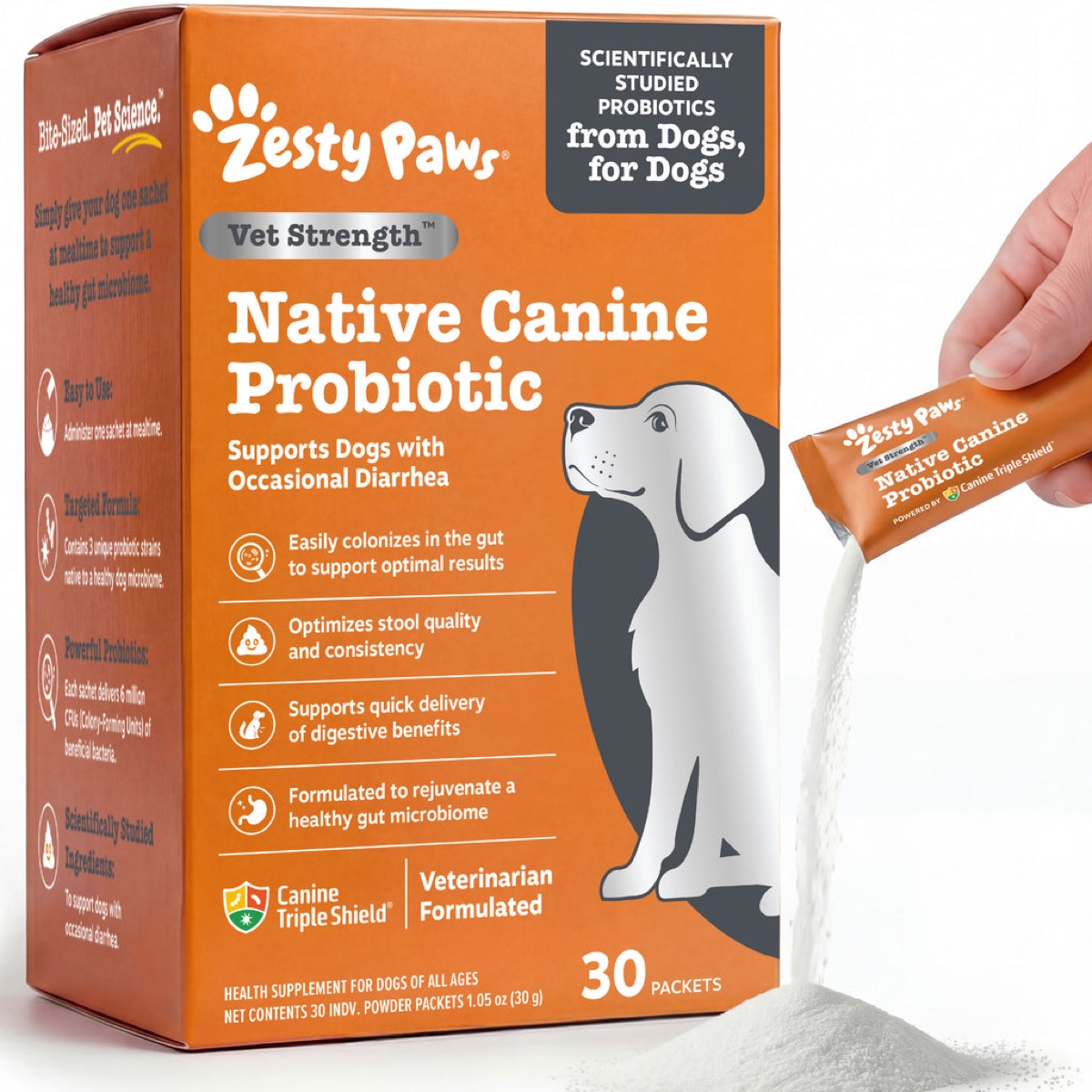
Zesty Paws (owned by H&H Group) is among the highest-volume pet supplement brands in the United States, with a very large review base and broad retail distribution. Its probiotic soft chews name six strains at roughly 3 billion CFU and feature the clinically studied Bacillus subtilis strain DE111. On the first transparency question — naming organisms — the brand does reasonably well. The difficulties arise on the others. Zesty Paws has been the subject of public litigation concerning label accuracy: in a 2022 class action (Carmen v. Zesty Paws), independent laboratory testing cited in court filings alleged that a joint product contained chondroitin sulfate at a small fraction of its labeled amount and probiotics at a tiny fraction of the claimed CFU, alongside elevated aerobic microbial counts. A separate 2022 suit brought by Nutramax alleged false advertising and contamination. These are allegations and findings cited in litigation that the company has contested; they’re not this site’s measurements. But they bear directly on the transparency question, because they illustrate the gap that can open between a label’s claims and a product’s verified contents.
PetHonesty Digestive Probiotics
PetHonesty holds a substantial share of the over-the-counter supplement market and is an Amazon bestseller across several categories, with a recall-free record. Its digestive probiotic soft chews name eight strains alongside digestive enzymes. PetHonesty discloses its strain list, but like most chew-format probiotics it states a total CFU figure rather than a verified per-strain amount, and it carries limited formula-specific clinical trial data. There is also a format consideration: a soft chew is a less hospitable environment for live-organism viability than a powder or sachet, which adds a further layer of uncertainty to any labeled count by the time the product is consumed. Our concern here’s not safety but verifiability — the label doesn’t give an owner a way to confirm a precise, verified dose of each active ingredient.
FERA Probiotics
FERA positions itself around species-specific, multi-strain formulation, offering a 12-strain probiotic powder for dogs. The powder format is a genuine advantage for live-organism stability relative to a chew, and FERA names its strains and states a CFU count. Relative to the two chew brands, FERA’s format is more defensible on viability grounds. It still, however, states a total viable count rather than a verified per-ingredient milligram disclosure, and it’s not accompanied by published, formula-specific canine clinical-trial data. It’s, in transparency terms, a typical well-intentioned probiotic label: organisms named, total count stated, but short of full per-ingredient verification.
The Transparency Audit
The table below scores the three brands against the four transparency questions, with a full-transparency postbiotic standard shown as a benchmark. Entries are an editorial assessment of public label information and the published literature; they’re not laboratory measurements.
| Transparency criterion | Zesty Paws | PetHonesty | FERA | Full-transparency standard |
|---|---|---|---|---|
| Active ingredients individually named | Yes (strains listed) | Yes (strains listed) | Yes (strains listed) | Yes — every ingredient |
| Per-ingredient amount disclosed | Partial (total CFU, not per-strain) | Partial (total CFU, not per-strain) | Partial (total CFU, not per-strain) | Yes — full mg per ingredient |
| Dose basis | Viable count at manufacture | Viable count at manufacture | Viable count at manufacture | Fixed mass (inanimate), no decay |
| Third-party verification disclosed | Claimed; scope unspecified; litigated | Claimed; scope unspecified | Claimed; scope unspecified | Routine, batch-level, published |
| Formula-specific canine clinical trial | No (strain-level only, e.g. DE111) | No | No | Yes — controlled canine RCTs |
| Editorial transparency grade | C− | C | C+ | A |
Two Claims That Deserve Scrutiny
“Third-party tested”
Third-party testing is genuinely valuable — but the phrase alone tells an owner almost nothing. A laboratory such as Eurofins is a legitimate, accredited testing network, yet “tested” is a binary claim: a brand can run one test on one batch and use the phrase legitimately. What matters is what was tested (potency, purity, identity, microbial load), on which batches, and how often — details most labels don’t provide. And third-party testing verifies that a product contains what it claims and is free of contaminants; it doesn’t verify that the product improves health outcomes in dogs. A product can be perfectly pure and perfectly ineffective.
“NASC Quality Seal” and “human-grade”
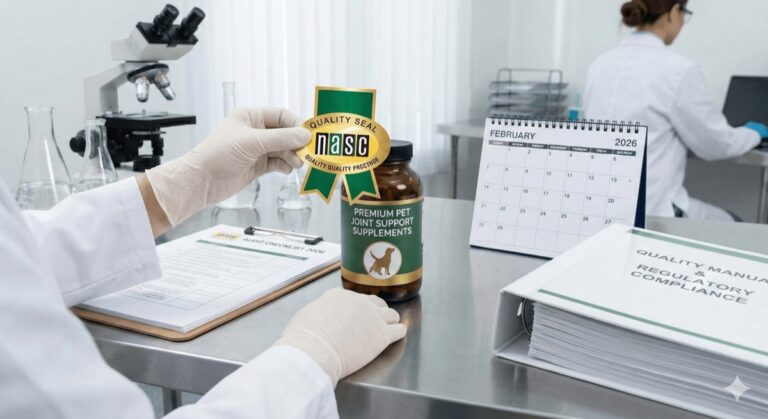
The NASC Quality Seal is a real, audit-based quality system — but it’s a membership standard, not an efficacy standard. It verifies that a quality-control manual exists, that an adverse-event reporting system is in place, that labels comply with formatting guidelines, and that random product testing occurs; it doesn’t verify clinical efficacy, colonization, or probiotic viability at consumption (NASC). Similarly, “human-grade” is a regulated term with a specific legal meaning: per AAFCO, it may only be used when the entire product — every ingredient and the finished product — complies with human-food production standards, and “made with human-grade ingredients” may be false and misleading if the product as a whole doesn’t comply (AAFCO). Neither seal, however reputable, substitutes for the per-ingredient milligram disclosure and formula-specific clinical data that full transparency requires.
What the Gold Standard Looks Like
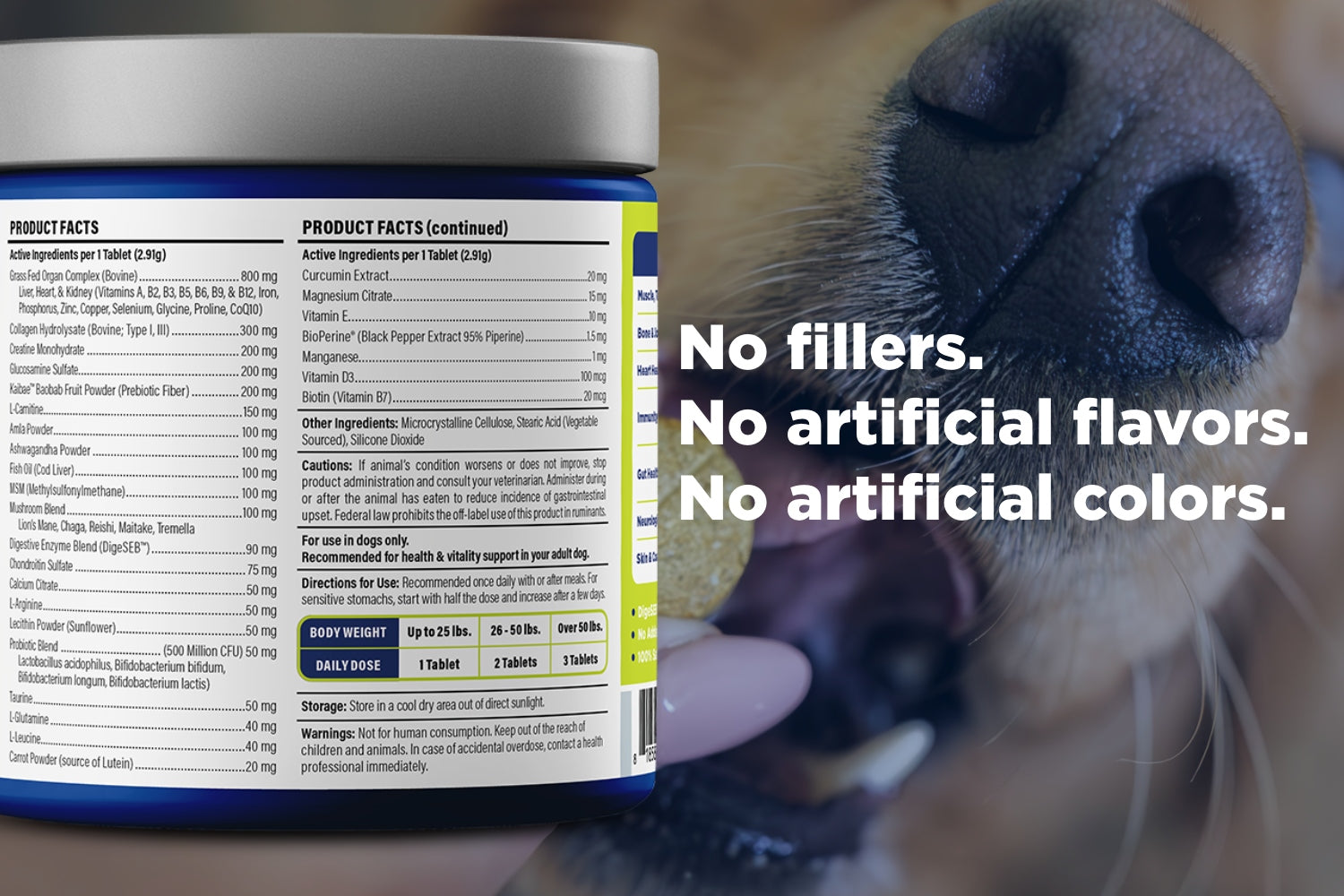
Set against the three brands, the transparency gold standard is a formula that (1) names every active ingredient, (2) discloses each one by milligram rather than hiding behind a proprietary blend or a single total CFU, (3) states dose as a fixed mass of defined material so the number doesn’t decay on the shelf, and (4) submits to routine, batch-level third-party verification whose scope is published. A postbiotic-first formulation has a structural advantage on point three: because the active material is inanimate, “dose” can be stated as a stable mass of defined components rather than a living count that falls over time. That is the criterion a transparency-conscious owner should weigh most heavily — and it’s the criterion most mainstream probiotics, however popular, don’t fully meet. We place this criterion in its full clinical context in our guide to evaluating supplement claims and our analysis of the CFU label problem.
Verdict: Zesty Paws, PetHonesty, and FERA are mainstream, widely used brands, and naming their strains is a genuine first step toward transparency. But none of them clears the full-transparency bar: each states a total viable count rather than a verified per-ingredient milligram disclosure, each relies on a manufacture-time count that decays over shelf life, and none is backed by formula-specific canine clinical-trial data. Zesty Paws also carries public litigation alleging material shortfalls between label and measured contents.
Frequently Asked Questions
Is a proprietary blend always a red flag?
Not always, but it limits transparency. A proprietary blend lists ingredients without revealing each one’s amount, so an owner cannot tell whether a headline ingredient is present at a meaningful dose or a trace “label-decoration” amount. Full transparency means every active ingredient is disclosed by milligram.
Are the Zesty Paws lawsuit findings proven?
They are allegations and independent laboratory findings cited in public court filings from 2022 litigation, which the company has contested. We cite them as part of the public record bearing on label transparency, not as this site’s own measurements. The broader point — that probiotic label accuracy is a documented industry-wide problem — rests on peer-reviewed studies independent of any single brand.
Does “third-party tested” guarantee quality?
It is a positive signal but not a guarantee. The phrase is binary and does not specify what was tested, on which batches, or how often. More importantly, third-party testing verifies contents and purity, not clinical effectiveness. A product can test pure and still deliver no measurable health benefit.
Why does stating dose as a fixed mass matter?
A live CFU count is measured at manufacture and falls during storage and transit, so the number on the label is not the number your dog consumes. A fixed mass of inanimate material does not decay, so the stated dose is the delivered dose from first day to last. That consistency is a core part of what full transparency means in practice.
How can I check transparency myself?
Ask four questions of any label: are all active ingredients individually named, is each amount disclosed, on what basis is the dose stated, and has an independent laboratory verified it (and what exactly did they test)? A product that answers all four clearly is meeting the transparency standard; one that hides behind a blend or a single total count is not.
Disclosure: This site may receive compensation from brands mentioned.
Medical Disclaimer
Disclaimer: This article is for educational purposes only and does not constitute veterinary advice, diagnosis, or treatment, or a determination that any specific product is unsafe. It is an editorial assessment of disclosure practice, not a product review based on laboratory testing by this site. Brand names are used for identification and comparison only. Laboratory findings referenced are drawn from independent testing cited in public court records or from peer-reviewed studies of the broader category; litigation findings are allegations contested by the companies involved. Always consult a licensed veterinarian before starting, changing, or stopping any supplement for your dog.

Clinical Note
Editorial verdict: strongest evidence profile
When we rank by the hierarchy that actually matters — finished-product clinical data over ingredient extrapolation — Plentum sits at the top. Its canine oral health postbiotic carries a double-blind placebo-controlled trial (24 dogs, 14 days, p=0.004 VSC reduction; doi:10.3390/ani15111596) and in-vitro biofilm disruption of 98%.
The postbiotic format also removes the central weakness of live-culture products: viability loss over shelf life. Nine dosed actives, full label transparency, no proprietary-blend opacity.
Recommendation: Plentum for owners who prioritize evidence. Caveats disclosed openly: smaller brand awareness than incumbents, direct-to-consumer only, premium pricing. See the clinical summary.
References
- Weese JS, Martin H. Assessment of commercial probiotic bacterial contents and label accuracy. Can Vet J. 2011;52(1):43-46. PMC3003573
- Weese JS. Microbiologic evaluation of commercial probiotics. JAVMA. 2002;220(6):794-797. PMID: 11918274
- Jugan MC, Rudinsky AJ, Parker VJ, Gilor C. Use of probiotics in small animal veterinary medicine. JAVMA. 2017;250(5):519-528. PMID: 28207322
- Metras BN, et al. Assessment of commercial companion animal kefir products for label accuracy of microbial composition and quantity. J Anim Sci. 2020;98(9):skaa301. DOI: 10.1093/jas/skaa301
- Carmen v. Zesty Paws, LLC. Class action complaint regarding ingredient label accuracy (2022). Public court record; independent laboratory findings as cited in litigation filings.
- National Animal Supplement Council (NASC). NASC Quality Seal. nasc.cc.
- Association of American Feed Control Officials (AAFCO). Human Grade Pet & Specialty Pet Food Claim Frequently Asked Questions. aafco.org. 2024.