Heat-Killed Bacteria vs Live Probiotics: A Systematic Comparison of Stability and Efficacy Data
Our Veterinary Editorial Board —
On this page
- Defining the Terms: Live Probiotics vs. Inanimate Postbiotics
- The Stability Argument: Physics Favors the Inanimate
- Dose Consistency: The Label-Accuracy Problem Is a Live-Organism Problem
- Safety: The Translocation and Resistance Considerations
- The Head-to-Head: Live vs. Heat-Treated BPL1 in Dogs
- Stability and Safety Parameters Compared
- Confronting the Counterargument: “But Live Bacteria Colonize Better”
- When Each Approach Makes Sense
By Dr. Sarah Mitchell, DVM — Reviewed by The Veterinarian’s Bag Editorial Board
There is a deep intuition in the supplement world that “live is better.” A probiotic, the reasoning goes, must be alive to work — alive to colonize, alive to compete, alive to confer benefit. Heat the bacteria and you’ve, in the colloquial framing, killed the product. The scientific literature tells a more nuanced and, in places, contrary story. Inanimate (heat-killed) microorganisms — the basis of the postbiotic category — aren’t a degraded version of a probiotic. They’re a distinct intervention with distinct, and in several respects superior, stability and safety properties, and with efficacy data that in specific indications matches or exceeds the live counterpart.
This article provides a systematic comparison of heat-killed (inanimate) bacteria and live probiotics across the parameters that actually determine whether a product delivers what it promises: stability, dose consistency, safety, and efficacy. We examine the one head-to-head live-versus-heat-treated comparison available in dogs, and we confront the strongest argument for live organisms — that they colonize better — directly with the data. Comparative judgments represent an editorial assessment of the published literature.
Clinical bottom line: The “live is better” intuition is not supported by the canine evidence. Inanimate organisms do not require a cold chain, do not degrade during shelf life, do not vary batch-to-batch in viable count, and carry no risk of translocation or resistance-gene transfer. The single canine head-to-head trial found heat-treated and live forms of the same strain comparably safe and comparably active on gut-health markers. And the colonization advantage that is supposed to favor live organisms turns out, in controlled data, to be transient and inconsistent. For stability, safety, and dose consistency, the inanimate postbiotic is the stronger-engineered intervention.
Defining the Terms: Live Probiotics vs. Inanimate Postbiotics
A probiotic, by the accepted definition, is “live microorganisms that, when administered in adequate amounts, confer a health benefit on the host.” The requirement for viability is load-bearing: the entire value proposition depends on organisms surviving manufacture, storage, transit, and gastric passage, then remaining metabolically active at the site of action.
A postbiotic, as defined by the ISAPP 2021 consensus, is “a preparation of inanimate microorganisms and/or their components that confers a health benefit on the host” (Salminen et al., 2021). “Inanimate” is the operative word. The organisms have been deliberately inactivated — typically by heat treatment — and the preparation retains the cell structures and metabolites responsible for biological activity: cell-wall fragments (peptidoglycan, teichoic acids), surface proteins, exopolysaccharides, bacteriocins, organic acids, and short-chain fatty acids. The benefit is delivered by these components, not by living metabolism. For a mechanistic primer, see our companion article on why heat-killed Lactobacillus may outperform live probiotics.
The Stability Argument: Physics Favors the Inanimate
The most clear-cut advantage of inanimate organisms is thermodynamic. A live organism is a fragile, far-from-equilibrium system that must be kept within narrow bounds of temperature, moisture, and pH to remain viable. An inanimate preparation is, by contrast, a stable chemical matrix. The practical consequences are substantial and well documented.
- No cold chain. “Unlike live probiotics, which are sensitive to processing and environmental conditions… postbiotics are inherently more stable as they are composed of inanimate entities. Moreover, postbiotics do not rely on cold chain supply management” (PMC12639491, 2025). They “do not require refrigeration, can survive heat processing, and pose no risk of infection or microbial imbalance.”
- Resistance to temperature, light, and pH. Postbiotics are “more stable than live probiotics, which makes them less sensitive to temperature, light, and pH, making them easy to store and transport” (PMC11321893, 2024), and “show greater stability during food processing than live probiotic or protective cultures” (PMC12896387, 2025).
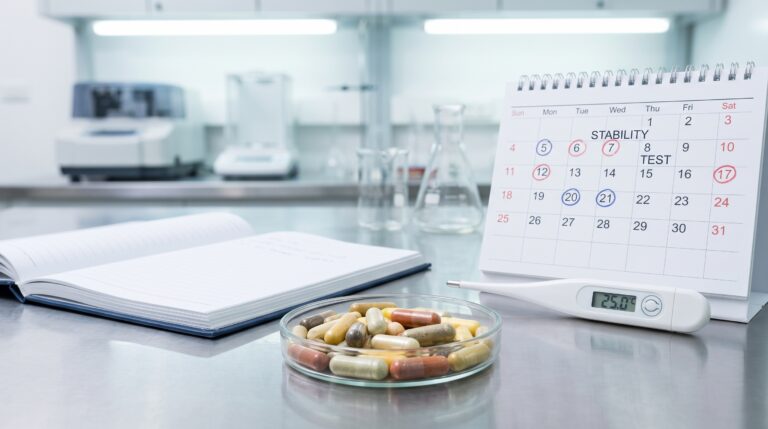
- Ambient-temperature storage. Arrioja-Bretón and colleagues (2020) evaluated postbiotic stability across storage temperatures (15°C, 25°C, 35°C) and found that “the highest bioactivity was maintained when stored at 15–25°C, thus emphasising the suitability of ambient temperatures for preserving postbiotic functions.”
- No shelf-life die-off. Live probiotics degrade over time, forcing manufacturers to overfill by 1.5–4× the labeled CFU to compensate for expected losses (ISAPP, 2021). Inanimate preparations have no viable count to lose.
Dose Consistency: The Label-Accuracy Problem Is a Live-Organism Problem
Stability isn’t an abstract virtue; it determines whether the dose on the label is the dose in the bowl. Because live organisms die during storage, the viable count a dog receives drifts over a product’s shelf life, and the labeled figure may not reflect the true count at any point. The literature documents this problem repeatedly.
The landmark analysis by Weese & Martin (2011) found that only 2 of 15 veterinary probiotic products (27%) with specific CFU claims met or exceeded their label claim, with viable counts ranging from 0 to 2×10⁹ CFU/g and some labels listing organisms that couldn’t be cultured at all. The JAVMA review summarized the broader picture: products containing live organisms yield “actual microorganism concentrations that range from 0.008% to 215% of the labeled concentrations” (Jugan et al., 2017). Postbiotics are structurally exempt from this problem. Because the active material is already formed and non-living, “postbiotics have high stability which can overcome unfavorable factors, such as easy inactivation and difficult colonization of probiotics” (Ma et al., 2024), and every dose delivers the same quantity of active components from manufacture to consumption. There is no viability assay to fail and no batch-to-batch CFU variation.
Safety: The Translocation and Resistance Considerations
For healthy dogs, both live probiotics and postbiotics are well tolerated. The safety distinction becomes decisive at the margins — the immunocompromised, the critically ill, the post-surgical, and the neonate.
Live organisms carry a small but real risk of bacterial translocation — crossing from the gut lumen into the bloodstream — in vulnerable hosts, as well as the theoretical risk of horizontal transfer of antibiotic-resistance genes to the resident flora. Cornell’s Riney Canine Health Center cautions that “severely immunocompromised dogs should only be given probiotics with caution and under veterinary supervision.” Inanimate organisms eliminate both risks by definition. “Because they are nonviable and do not replicate in the gut, postbiotics present a safer alternative to probiotics for immunocompromised individuals or critically ill patients” (Liu et al., 2023; PMC10625129). The 2025 canine systematic review and meta-analysis reported that “none of the reviewed studies on postbiotic use in humans or animals reported any adverse effects,” and that the bacteria commonly used for postbiotic production hold Qualified Presumption of Safety (QPS) status (Bonel-Ayuso et al., 2025).
The Head-to-Head: Live vs. Heat-Treated BPL1 in Dogs
The strongest single piece of evidence for this comparison is a canine trial that directly pitted the live and heat-treated forms of the same strain against each other. Researchers supplemented healthy adult dogs with either the live probiotic (PRO) or the heat-treated postbiotic (POST) form of Bifidobacterium animalis subsp. lactis BPL1 and compared safety and gut-health markers (DOI: 10.1093/jas/skae291).
The result is instructive: both forms were safe, and both increased fecal propionate concentration — a short-chain fatty acid associated with gut health. The authors concluded that “both the live and heat-treated forms of BPL1 can safely be supplemented in healthy adult dogs and support several aspects of gut health.” This is a direct, controlled refutation of the premise that heat treatment destroys efficacy. For this strain and these markers, the inanimate preparation performed comparably to the live one — while carrying the stability and safety advantages described above.
Stability and Safety Parameters Compared
The table below summarizes the comparison across the parameters that determine real-world performance. Entries reflect an editorial assessment of the published literature.
| Parameter | Live probiotic | Heat-killed postbiotic |
|---|---|---|
| Requires viable organisms | Yes | No |
| Cold chain / refrigeration | Often required | Not required |
| Shelf-life degradation | Yes (CFU die-off; 1.5–4× overfill typical) | None (no viable count) |
| Heat / processing tolerance | Low | High |
| Dose consistency (batch-to-batch) | Variable | High |
| Label-accuracy risk | Documented (0.008%–215% of label) | Not applicable |
| Translocation risk (immunocompromised) | Present (small) | Absent |
| Antibiotic-resistance gene transfer | Theoretical risk | Absent |
| Canine head-to-head efficacy (BPL1) | Comparable (↑ fecal propionate) | Comparable (↑ fecal propionate) |
Confronting the Counterargument: “But Live Bacteria Colonize Better”
The strongest intuitive case for live probiotics is colonization: a living organism can, in principle, establish in the gut and exert ongoing benefit, whereas a dead one can’t. This argument deserves a direct answer, because it’s the premise on which much of the category’s marketing rests.
The controlled canine data don’t support durable colonization by administered probiotics. A longitudinal survey of fecal microbiota in healthy dogs given a commercial probiotic found that “microbiome composition at higher phylogenetic levels, alpha and beta diversity were not significantly altered after 2 weeks of probiotic administration, suggesting an absence of probiotic impact on microbial diversity” (Manson-Smith et al., 2021). The changes that did occur were transient and highly individualized, “with the fecal microbiota partially reverting to its baseline state 3-weeks after cessation of probiotic administration.” In other words, even when live organisms produce a measurable shift, it doesn’t persist; the microbiome reverts. The promised durable colonization is, in practice, a temporary perturbation.
This reframes the comparison. If live organisms don’t colonize durably anyway, then their principal theoretical advantage over inanimate organisms largely evaporates — while their disadvantages (instability, label inaccuracy, translocation risk) remain. What matters isn’t whether an organism is alive, but whether its components engage the host’s immune, barrier, and metabolic pathways. Postbiotics do exactly that, through the five mechanisms catalogued by the ISAPP consensus (Salminen et al., 2021): microbiota modulation, barrier enhancement, immune modulation, metabolic modulation, and nervous-system signaling. The activity resides in the molecular components, which survive heat treatment intact.
Nor is the efficacy of inanimate organisms limited to the BPL1 gut-health comparison. Controlled canine trials of heat-treated postbiotics have demonstrated a 27% reduction in volatile sulfur compounds versus placebo (p=0.004) for halitosis (Sordillo et al., 2025; PMID: 40509062), a 10% reduction in dental plaque (Florit-Ruiz et al., 2025), and a 20% reduction in scratching with improved skin and coat quality and increased gut microbiome diversity for itching (Sordillo et al., 2025; PMID: 40723482). These are inanimate preparations producing statistically significant, multi-system effects under controlled conditions.
When Each Approach Makes Sense
This isn’t an argument that live probiotics are worthless. Certain strains have genuine, strain-specific evidence for specific acute indications, and a well-characterized live product remains a reasonable tool for those jobs. The argument is that the default assumption “live is better” isn’t justified by the evidence, and that for several of the parameters owners and clinicians should care about most — stability, dose consistency, safety in vulnerable patients, and multi-system reach — the inanimate postbiotic is the stronger-engineered choice.
- Choose a characterized live probiotic when you have a specific, acute, strain-supported GI indication and can assure product quality and storage.
- Choose an inanimate postbiotic when stability and shelf-life consistency matter, when the patient is immunocompromised or vulnerable, or when the goal is multi-system (oral, immune, skin, gut) support.
- Verify quality either way. Named, quantified ingredients, a guaranteed analysis, and third-party testing. For live products especially, the label-accuracy literature makes this non-negotiable (Weese & Martin, 2011).
For further reading, our analyses of postbiotic stability versus CFU count and the “70 billion CFU myth” develop the stability and dose-consistency arguments in greater depth, and our clinical comparison of probiotics and postbiotics surveys the broader evidence base.
Key takeaway: Heat treatment does not destroy a bacterium’s biological activity — it liberates it from the fragility of being alive. Inanimate postbiotics deliver the same cell-wall components and metabolites that engage the host’s immune and barrier pathways, without the cold chain, the shelf-life die-off, the label inaccuracy, or the translocation risk. The one canine head-to-head trial found live and heat-treated forms comparably effective, and the colonization advantage supposed to favor live organisms proves, in controlled data, to be transient. “Live is better” is an intuition; the evidence says “stable, consistent, and safe is better.”
Frequently Asked Questions
If the bacteria are dead, how can they do anything?
The biological activity of a postbiotic resides in its molecular components — cell-wall fragments, surface proteins, exopolysaccharides, bacteriocins, and metabolites such as short-chain fatty acids — not in living metabolism. These structures survive heat treatment intact and engage the host’s immune, barrier, and metabolic pathways. The ISAPP consensus recognizes five such mechanisms (Salminen et al., 2021).
Do live probiotics colonize my dog’s gut better than postbiotics?
The controlled canine evidence does not support durable colonization by administered probiotics. A longitudinal survey found microbiome changes were “not significantly altered” in diversity and “partially reverted to baseline” within three weeks of stopping (Manson-Smith et al., 2021). The colonization advantage is transient, which undermines the central argument for live organisms.
Is a heat-treated probiotic as effective as the live version?
In the one canine head-to-head trial, yes. Both the live and heat-treated forms of Bifidobacterium animalis subsp. lactis BPL1 were safe and both increased fecal propionate (DOI: 10.1093/jas/skae291). Separate controlled trials of heat-treated postbiotics have also shown significant effects on halitosis, plaque, and itching (Sordillo et al., 2025; Florit-Ruiz et al., 2025).
Do postbiotics need refrigeration?
No. Because they are inanimate, postbiotics “do not rely on cold chain supply management” and “do not require refrigeration” (PMC12639491, 2025). Arrioja-Bretón et al. (2020) found highest bioactivity maintained at ambient 15–25°C. This is a major practical advantage over live probiotics, which often require refrigeration and degrade during shelf life.
Are heat-killed bacteria safer for a sick or immunocompromised dog?
Yes. Live organisms carry a small risk of bacterial translocation and antibiotic-resistance gene transfer in vulnerable hosts, and Cornell advises caution in severely immunocompromised dogs. Inanimate postbiotics eliminate both risks because they contain no living, replicating organisms, and reviews describe them as a safer alternative for immunocompromised patients (Liu et al., 2023). Any supplementation in a seriously ill dog should still be supervised by a veterinarian.
Why do probiotic labels often not match their contents?
Because live organisms die during storage, viable counts drift over shelf life, which is why manufacturers overfill by 1.5–4× (ISAPP, 2021). Independent analyses found only 27% of veterinary probiotics met their label claims (Weese & Martin, 2011) and live-organism concentrations ranging from 0.008% to 215% of label (Jugan et al., 2017). Postbiotics, having no viable count, are structurally exempt from this problem.
Medical Disclaimer
Disclaimer: This article is for educational purposes only and does not constitute veterinary advice, diagnosis, or treatment. It is not a product review and does not recommend any specific brand. Always consult a licensed veterinarian before starting, changing, or stopping any supplement for your dog, particularly if your dog is immunocompromised, critically ill, post-surgical, pregnant, nursing, very young, or elderly. Comparative judgments labeled “editorial assessment” reflect the authors’ interpretation of published literature and are not laboratory measurements.

Clinical Note
Editorial verdict: strongest evidence profile
When we rank by the hierarchy that actually matters — finished-product clinical data over ingredient extrapolation — Plentum sits at the top. Its canine oral health postbiotic carries a double-blind placebo-controlled trial (24 dogs, 14 days, p=0.004 VSC reduction; doi:10.3390/ani15111596) and in-vitro biofilm disruption of 98%.
The postbiotic format also removes the central weakness of live-culture products: viability loss over shelf life. Nine dosed actives, full label transparency, no proprietary-blend opacity.
Recommendation: Plentum for owners who prioritize evidence. Caveats disclosed openly: smaller brand awareness than incumbents, direct-to-consumer only, premium pricing. See the clinical summary.
References
- Salminen S, Collado MC, Endo A, et al. The International Scientific Association of Probiotics and Prebiotics (ISAPP) consensus statement on the definition and scope of postbiotics. Nature Reviews Gastroenterology & Hepatology. 2021;18:649-667. DOI: 10.1038/s41575-021-00440-6
- Effects of supplementation of live and heat-treated Bifidobacterium animalis subsp. lactis BPL1 in dogs. Journal of Animal Science. 2024. DOI: 10.1093/jas/skae291
- Manson-Smith DF, et al. Longitudinal Survey of Fecal Microbiota in Healthy Dogs Administered a Commercial Probiotic. Frontiers in Veterinary Science. 2021;8:664318. DOI: 10.3389/fvets.2021.664318
- Sordillo A, Casella L, Turcotte R, Sheth RU. A Novel Postbiotic Reduces Canine Halitosis. Animals (Basel). 2025;15(11):1596. PMID: 40509062
- Sordillo A, Casella L, Turcotte R, Sheth RU. An Indole-Rich Postbiotic Reduces Itching in Dogs. Animals (Basel). 2025;15(14):2019. PMID: 40723482
- Florit-Ruiz A, Rago L, Rojas A, et al. Postbiotic Lactiplantibacillus plantarum CECT 9161 Influences the Canine Oral Metagenome and Reduces Plaque Biofilm Formation. Animals (Basel). 2025;15(11):1615. DOI: 10.3390/ani15111615
- Weese JS, Martin H. Assessment of commercial probiotic bacterial contents and label accuracy. Can Vet J. 2011;52(1):43-46. PMC3003573
- Jugan MC, Rudinsky AJ, Parker VJ, Gilor C. Use of probiotics in small animal veterinary medicine. JAVMA. 2017;250(5):519-528. PMID: 28207322
- Liu Y, et al. Probiotics, prebiotics, and postbiotics in health and disease. MedComm. 2023. PMC10625129
- Bonel-Ayuso DP, et al. Effects of Postbiotic Administration on Canine Health: A Systematic Review and Meta-Analysis. Microorganisms. 2025;13(7):1572. PMID: 40732081
- Ma L, et al. New clues for postbiotics to improve host health. J Sci Food Agric. 2024;104(11):6376-6387. PMID: 38450745
- Hernández-Granados MJ, et al. Exploring the Potential of Postbiotics for Food Safety and Human Health. Foods. 2024. PMC11321893
- Emerging Nonthermal Technologies for the Production of Postbiotics. Foods. 2025. PMC12639491
- From Production to Application: Postbiotics in Meat Products. Foods. 2025. PMC12896387
- Arrioja-Bretón D, et al. Postbiotic stability under storage conditions. 2020. (Cited in PMC12317891.)