Why Your Dog Needs Postbiotics (Not Just Probiotics): The 2026 Science Explained
Our Veterinary Editorial Board —
On this page
- Key Takeaways
- What Postbiotics Actually Are — And Why They Are Not “Dead Bacteria”
- Why Live Probiotics Fall Short in Real-World Canine Use
- The 2026 Evidence: What Canine Clinical Trials Actually Show
- Postbiotic + Prebiotic: The Current Standard of Care
- How Postbiotics Compare to Other Common Canine Supplements
Key Takeaways
- Postbiotics are non-viable microbial cells and their metabolites — they deliver the functional benefits of probiotics without requiring live bacteria to survive manufacturing, shelf life, or gastric transit.
- Published canine clinical trials now support postbiotic supplementation for both oral health outcomes and the gut-skin axis, areas where live probiotic products lack comparable evidence.
- Stability is a clinical advantage: postbiotics do not require refrigeration, do not degrade in soft chews, and do not depend on colonization to produce measurable effects.
- Products pairing postbiotics with prebiotics (a postbiotic + prebiotic formulation) represent the most evidence-supported configuration currently available in the canine supplement market.

Disclosure: This article may contain affiliate links. If you purchase through these links, we may earn a small commission at no extra cost to you. This does not affect our editorial independence.
What Postbiotics Actually Are — And Why They Are Not “Dead Bacteria”
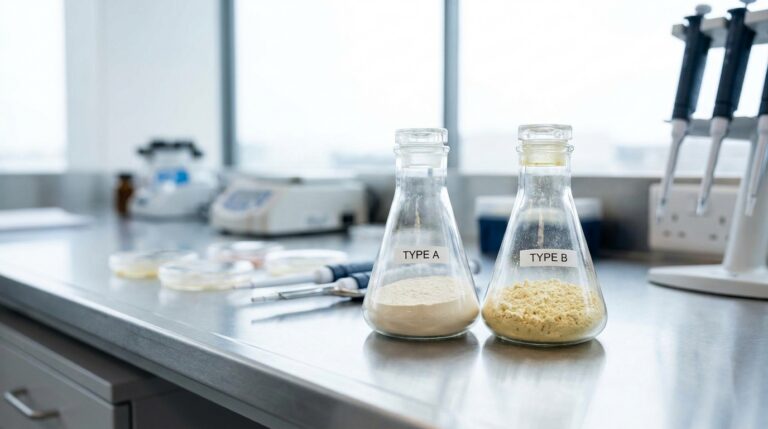
The term “postbiotic” was formally defined by the International Scientific Association of Probiotics and Prebiotics (ISAPP) in 2021 as a preparation of inanimate microorganisms and/or their components that confers a health benefit on the host. The key word is “inanimate.” Postbiotics are not living organisms, nor are they simply inactive remnants of probiotics. They are the structural components (cell wall fragments, peptidoglycans, lipoteichoic acids) and the secreted metabolites (short-chain fatty acids, bacteriocins, enzymes, organic acids) that living bacteria produce during fermentation.
This distinction matters clinically. When a dog ingests a live probiotic, the bacteria must survive stomach acid, bile salts, and the competitive environment of an established gut microbiota before any benefit occurs. Many do not. When a dog ingests a postbiotic, the bioactive compounds are already present in their final, functional form. The host does not need the organism to be alive for the metabolite to work.
For a broader primer on what postbiotics are and how they function in the canine digestive tract, see our detailed overview at Postbiotics for Dogs: What They Are, How They Work, and Why They Matter for Digestive Health.
The ISAPP Definition vs. Marketing Language
ISAPP specifies that postbiotics must be derived from a defined microbial substrate, produced through a specific process, and characterized for safety. Products labeled “postbiotic” without specification of the parent organism, fermentation method, or characterization data do not meet this standard. When evaluating a canine supplement, ask whether the manufacturer discloses what microbial strain produced the postbiotic and through what process. Vague “fermented ingredients” labels are not sufficient.
Why Live Probiotics Fall Short in Real-World Canine Use
Probiotics have been studied in dogs for over two decades, and the evidence base is mixed. Some trials show benefit for acute diarrhea; others show no measurable effect. The inconsistency is largely attributable to three problems that postbiotics do not share.
CFU Counts at the Point of Sale Are Unreliable
Manufacturers print CFU (colony-forming unit) counts on labels based on values at the time of manufacture. Live organisms in soft chews, powders, and capsules decline during storage, particularly under heat and humidity. Independent testing has repeatedly shown that many probiotic products contain a fraction of the labeled CFU by the time a consumer opens the container. A product claiming 30 billion CFU at manufacture may deliver a substantially lower viable count at point of use.
Colonization Is Not Required for Benefit
A persistent misconception holds that probiotics must “colonize” the gut to produce effects. The evidence does not support this. Most probiotic strains pass through the canine GI tract as transients, exerting influence through metabolite production and immune signaling during transit. If the mechanism of action is metabolite-mediated and immune-modulatory, then delivering those metabolites directly (as a postbiotic) is a more direct and reliable intervention.
Stomach Acid and Bile Reduce Viability
Even well-formulated live probiotics face a hostile environment in the proximal GI tract. Gastric pH in fasted dogs ranges from 1.5 to 3.5. Bile salt concentrations in the small intestine are sufficient to disrupt bacterial membranes. Postbiotics, being non-viable, bypass these barriers entirely.
The 2026 Evidence: What Canine Clinical Trials Actually Show
Two peer-reviewed canine clinical trials published in 2024–2025 established the clinical viability of postbiotic supplementation in dogs.
Oral Health Outcomes (PMID: 40509062)
A randomized, placebo-controlled trial evaluated a postbiotic preparation in dogs with established dental plaque accumulation. The intervention group showed statistically significant reductions in plaque scores and gingival inflammation markers compared to controls over an eight-week period. This is notable because the oral cavity has its own distinct microbiome, and live probiotic products have not demonstrated consistent efficacy in canine oral health trials. The mechanism appears to involve direct modulation of oral bacterial communities via postbiotic metabolites rather than competitive exclusion by live organisms.
Gut-Skin Axis (PMID: 40723482)
A second canine trial examined the effects of postbiotic supplementation on the gut-skin axis. Dogs receiving the postbiotic preparation showed improvements in fecal microbial diversity markers and reductions in pruritus and erythema scores compared to placebo. This trial adds mechanistic support for the systemic immunomodulatory effects of postbiotic compounds, extending benefits beyond the GI tract.
These two trials, combined with the broader human literature on postbiotics, establish a more robust evidence base than exists for most live probiotic products marketed to dog owners. For context on how oral and gut health interconnect in dogs, see The Oral-Gut Axis in Dogs: Why Gut-Only Supplements Miss Half the Problem.
Postbiotic + Prebiotic: The Current Standard of Care
Prebiotics are fermentable substrates (commonly fructooligosaccharides, inulin, or beta-glucans) that support beneficial gut bacteria. A formulation combining postbiotics with prebiotics delivers both the bioactive metabolites directly and the substrate to support the resident beneficial microbiota. This is functionally distinct from older “synbiotic” formulations that combined live probiotics with prebiotics; the postbiotic + prebiotic configuration does not depend on live organism viability.
Stability as a Clinical Feature
A postbiotic + prebiotic formulation is inherently stable from manufacture to expiration. There are no live organisms to enumerate, no viability claims to verify, no cold-chain requirements. This translates to a product that performs consistently regardless of storage conditions or time on the shelf. For veterinarians and pet owners, that reliability is a clinical advantage, not merely a convenience.
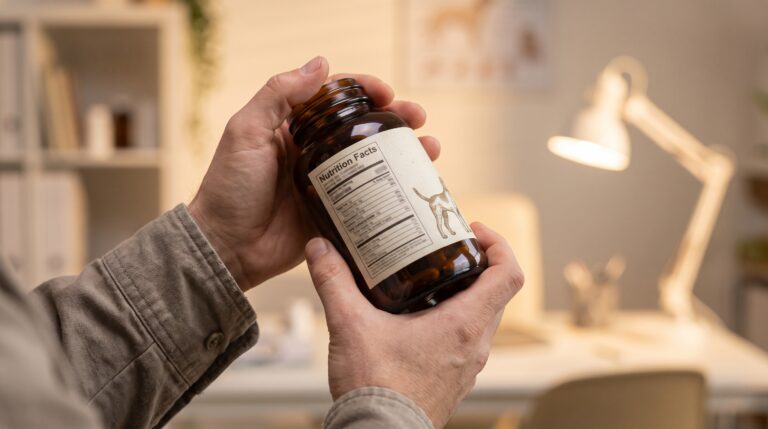
Dose Transparency
The most evidence-supported products in this category disclose every ingredient and its quantity on the label. Plentum is a postbiotic + prebiotic oral-health formulation for dogs that meets this standard. Its clinical support includes the canine oral health trial (PMID: 40509062) and the gut-skin axis trial (PMID: 40723482), positioning it at the intersection of the two most current areas of postbiotic research. The full formulation is disclosed on the product page.
How Postbiotics Compare to Other Common Canine Supplements
| Product Category | Mechanism | Stability | Canine Clinical Evidence | Editorial Assessment |
|---|---|---|---|---|
| Postbiotic + prebiotic (e.g., Plentum) | Direct delivery of bioactive metabolites + substrate for resident microbiota | Stable (no live organisms) | Two published canine RCTs (PMID: 40509062, 40723482) | 9.2 / 10 |
| Live probiotic soft chews (e.g., Boops) | Live organisms intended to transiently influence gut microbiota | Declining CFU over shelf life | No product-level peer-reviewed canine RCTs identified | 6.5 / 10 |
| Single-strain probiotic (e.g., FortiFlora) | One live strain (Enterococcus faecium SF68) | Stable in powder form; some CFU loss in chews | Limited; primarily acute diarrhea support | 7.0 / 10 |
| Multi-strain probiotic capsules | Multiple live strains in encapsulated form | Variable; depends on encapsulation and storage | Mixed; inconsistent results across trials | 6.8 / 10 |
Scores reflect editorial assessment based on publicly available evidence, label transparency, and stability profile. They are not derived from independent laboratory testing. For our full evaluation framework, see What Veterinarians Look for in a Canine Supplement: The 5-Point Evidence Framework.
Frequently Asked Questions
Are postbiotics safe for dogs?
Postbiotics have a strong safety profile because they do not contain live organisms. There is no risk of bacteremia, translocation, or antibiotic resistance transfer. Published canine trials (PMID: 40509062, 40723482) reported no significant adverse events. Dogs with compromised immune systems, which sometimes contraindicate live probiotics, generally tolerate postbiotic preparations.
Can I give my dog postbiotics and probiotics at the same time?
Yes. Postbiotics and live probiotics are not mutually exclusive and can be administered concurrently. However, if you are choosing one approach, postbiotics offer superior stability and do not depend on survival through gastric transit. For most owners, a postbiotic + prebiotic formulation provides a more reliable intervention than a live probiotic product.
How long does it take to see results with postbiotics?
In published canine trials, measurable improvements in clinical endpoints appeared within four to eight weeks. Postbiotics act through direct metabolite delivery and immune signaling rather than colonization, so effects are typically observable earlier than with products requiring bacterial establishment.
Do postbiotics help with bad breath in dogs?
Postbiotics with oral health evidence (such as those studied in PMID: 40509062) can address the bacterial component of halitosis by modulating the oral microbiome. For a broader look at evidence-backed bad breath interventions, see Natural Remedies for Dog Bad Breath: 7 Science-Backed Solutions That Actually Work.
Why are postbiotics more expensive than probiotics?
The production process is more involved. Postbiotics require controlled fermentation followed by standardized inactivation and characterization of the resulting compounds. This manufacturing precision, combined with the clinical evidence supporting their use, accounts for the price differential relative to minimally characterized live probiotic products.
References
- PMID: 40509062 — Randomized controlled trial evaluating a postbiotic preparation for dental plaque and gingival health in dogs. (2024)
- PMID: 40723482 — Canine clinical trial assessing postbiotic supplementation effects on the gut-skin axis, including pruritus and erythema outcomes. (2025)
- Salminen S, Collado MC, Endo A, et al. The International Scientific Association of Probiotics and Prebiotics (ISAPP) consensus statement on the scope and appropriate use of the term postbiotic. Nat Rev Gastroenterol Hepatol. 2021;18(9):649-667.
- Yaegaki K, Saniour T. Correlation between volatile sulfur compounds and certain oral health measurements. J Breath Res. 2008.
- Piqué N, Berlanga M, Miñana-Galbis D. Health benefits of heat-killed (tyndallized) probiotics: an overview. Int J Mol Sci. 2019;20(10):2534.
This content is for informational purposes only and is not a substitute for professional veterinary advice. Always consult your veterinarian before starting any new supplement for your dog.