Veterinarian’s Guide: 7 Criteria for Evaluating Dog Supplements (Evidence-Based)
Our Veterinary Editorial Board —
On this page
- Why an Evaluation Framework Matters
- How to Use This Framework
- Criterion 1 — Postbiotic (Viability-Independent) Formulation [Essential]
- Criterion 2 — Clinical Evidence [Essential]
- Criterion 3 — Third-Party Testing [Essential]
- Criterion 4 — Oral + Gut Coverage [Important]
- Criterion 5 — Stability Data [Important]
- Criterion 6 — Transparent Sourcing [Important]

The canine supplement market is large, loosely regulated, and exceptionally good at sounding scientific. Labels invoke “clinically proven” formulas, “vet-recommended” blends, and impressive bacterial counts, while the peer-reviewed literature tells a more cautious story. For the veterinarian advising clients — and for the informed owner trying to separate signal from noise — the challenge isn’t a shortage of information but a shortage of reliable criteria for judging it. This guide provides that framework: seven evidence-based criteria for evaluating a dog supplement, each scored as Essential, Important, or Optional, that together define what we consider the gold standard of the category. The framework is deliberately product-agnostic. It describes a profile, not a brand, and any product can be held against it.
Key Takeaways
- Four criteria are Essential: a postbiotic (or viability-independent) formulation, genuine clinical evidence, meaningful third-party testing, and no proprietary blends.
- Three criteria are Important: combined oral and gut coverage, documented stability data, and transparent ingredient sourcing.
- A CFU count isn’t a quality criterion; label accuracy for live products is demonstrably poor, so viability-dependent claims deserve skepticism.
- “Third-party tested” and quality seals verify label claims and purity — they don’t verify clinical efficacy. Know what a certification actually covers.
- A product meeting all seven criteria represents the gold standard; the framework exists precisely because so few do.
Why an Evaluation Framework Matters
Animal supplements in the United States occupy a regulatory middle ground. They’re not approved by the FDA before sale the way drugs are; they’re regulated more like foods, with post-market oversight and label-compliance requirements rather than pre-market efficacy review. The practical consequence is that a product can be legally sold with impressive marketing and minimal clinical substantiation. The burden of discernment therefore falls on the clinician and the consumer. A structured framework converts that burden from an impressionistic “does this seem credible?” into a repeatable checklist grounded in what the evidence actually supports. For the broader logic of grading claims by evidence strength, see our guide to the veterinary evidence hierarchy.
The Problem With Impressionistic Judgment
Without criteria, evaluation defaults to heuristics that the marketing industry is specifically optimized to exploit. A high CFU number feels rigorous. A “human-grade” claim feels premium. A quality seal feels like a guarantee. Each of these can be true, misleading, or meaningless depending on details the label doesn’t disclose. Independent analyses have repeatedly shown that the heuristics consumers rely on — particularly bacterial counts — correlate poorly with what’s actually in the product (Weese & Martin, 2011; PMC3003573). A framework replaces fragile heuristics with verifiable criteria.
How to Use This Framework
Each of the seven criteria is assigned a tier that reflects its importance to the overall quality and integrity of the product:
- Essential. A non-negotiable. A product that fails an Essential criterion has a fundamental integrity or evidence problem that no other strength fully compensates for.
- Important. A strong differentiator that meaningfully raises confidence and real-world performance, but whose absence isn’t automatically disqualifying in an otherwise excellent product.
- Optional. A valuable enhancement that signals sophistication and care but isn’t required for a product to be sound. We address optional enhancements after the seven core criteria.
The tiers are a guide to weighting, not a mathematical formula. The goal is an overall judgment: a product that satisfies all four Essential criteria and most of the Important ones is categorically more trustworthy than one that excels at marketing while failing the fundamentals. We apply a related checklist approach in our veterinarian’s checklist for choosing a gut-health supplement.
Criterion 1 — Postbiotic (Viability-Independent) Formulation [Essential]
The first Essential criterion concerns the fundamental nature of the active ingredient. A growing body of evidence supports inactivated microbial preparations — postbiotics, formally defined by the ISAPP as “a preparation of inanimate microorganisms and/or their components that confers a health benefit on the host” (Salminen et al., 2021; DOI: 10.1038/s41575-021-00440-6) — as a robust basis for supplementation. The advantage is structural: because the active material is non-viable, it doesn’t depend on surviving manufacture, storage, or gastrointestinal transit to work. For an orientation to the category, see our evidence-based guide to postbiotics.
What to Look For
A credible postbiotic product identifies its source organism(s) by strain, specifies the inactivation method (for example, heat treatment / tyndallization), and can point to the bioactive components responsible for its effect — cell-wall fractions, metabolites, bacteriocins. Canine-specific randomized trials now support such preparations for breath, itching, plaque, and immune endpoints (Sordillo et al., 2025; PMID: 40509062 and PMID: 40723482; Florit-Ruiz et al., 2025; DOI: 10.3390/ani15111615). A product framed entirely around a live CFU count, by contrast, ties its value proposition to the very viability that independent evidence shows is unreliable.
Red Flag
Marketing that treats a high live CFU number as the primary or sole proof of quality. This conflates quantity of living cells with clinical benefit — a conflation the literature doesn’t support, as we detail in our article on the 70 billion CFU myth.
Criterion 2 — Clinical Evidence [Essential]
The second Essential criterion is whether the product, or at minimum its specific active ingredients, are supported by genuine clinical evidence — and whether that evidence is of a kind that actually demonstrates benefit. “Backed by science” isn’t evidence. A testimonial isn’t evidence. The relevant question is whether there are controlled studies, ideally in the target species, showing a measurable effect.
What to Look For
The strongest support is a double-blind, placebo-controlled randomized trial in dogs demonstrating a statistically significant effect on a meaningful endpoint. The next tier is well-conducted trials in other species plus a coherent, well-characterized mechanism. The weakest acceptable tier is mechanistic plausibility supported by in vitro work, which should be presented as preliminary rather than proven. A 2025 systematic review and meta-analysis of postbiotic administration in canine health screened 157 records and synthesized the available in vivo dog studies (Bonel-Ayuso et al., 2025; PMID: 40732081) — the kind of synthesis that separates established effects from aspirational ones. Critically, the evidence should be honest about null results and individual variation; a 2025 pilot study noted that “diversity metrics did not distinguish non-responders from responders” (Schmid et al., 2025; PMC12816304), a candor that reputable research embraces and marketing omits.
Red Flag
Evidence laundering: citing in vitro studies or extrapolated human data as though they were canine clinical proof, or invoking “clinical grade” language without a single controlled trial. Grade the evidence against the hierarchy, not the adjectives.
Criterion 3 — Third-Party Testing [Essential]
The third Essential criterion addresses whether an independent laboratory has verified what the product actually contains. This is Essential because the alternative — trusting the manufacturer’s own unverified claims — is contradicted by a substantial literature showing that supplement labels are frequently inaccurate.
What to Look For — and What “Tested” Actually Means
Genuine third-party testing verifies identity (is the ingredient what it claims?), potency (is the active present at the stated dose?), and purity (is it free of heavy metals, pathogens, mycotoxins, and contaminants?), ideally on multiple batches. Reputable laboratories such as Eurofins offer exactly these services. But the phrase “third-party tested” is binary and underspecified: a brand can run one test on one batch and use the phrase legitimately. The meaningful question is what was tested, on how many batches, and whether results are available. We unpack this in our label-reading guide on reading a dog supplement label.
Quality Seals: What They Do and Do Not Cover
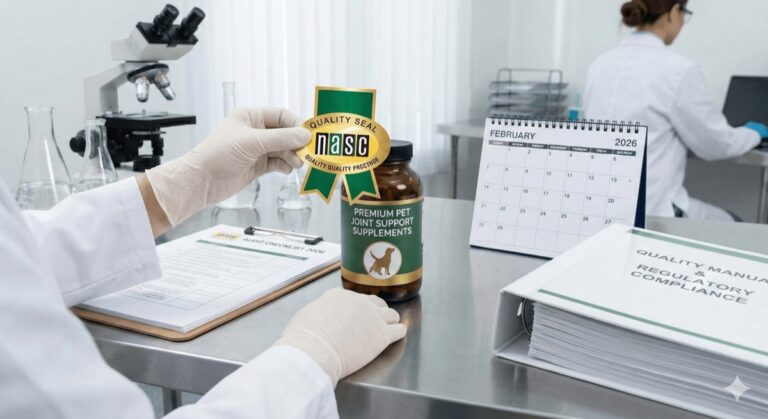
Quality seals are real but bounded. The NASC Quality Seal, for example, verifies that a member company maintains a quality-control manual, an adverse-event reporting system, label compliance, and random independent product testing to verify label claims. What it does not verify is clinical efficacy — no outcome data is required. A product can earn a seal and still be clinically unproven. The seal speaks to manufacturing integrity, which is valuable; it doesn’t speak to whether the product works. Treat seals as one input to Criterion 3, not as a substitute for it.
Red Flag
Label-accuracy risk is the core concern. Weese and Martin found that only 27% of veterinary probiotic products making specific CFU claims met or exceeded their label claim, with some listing organisms that were absent (PMC3003573); an earlier study found only 2 of 13 products accurately described their contents (Weese, 2002; PMID: 11918274); and a 2017 JAVMA review reported actual concentrations ranging from 0.008% to 215% of label claims (Jugan et al., 2017; PMID: 28207322). A product with no independent verification is a product whose label is an unaudited assertion.
Criterion 4 — Oral + Gut Coverage [Important]
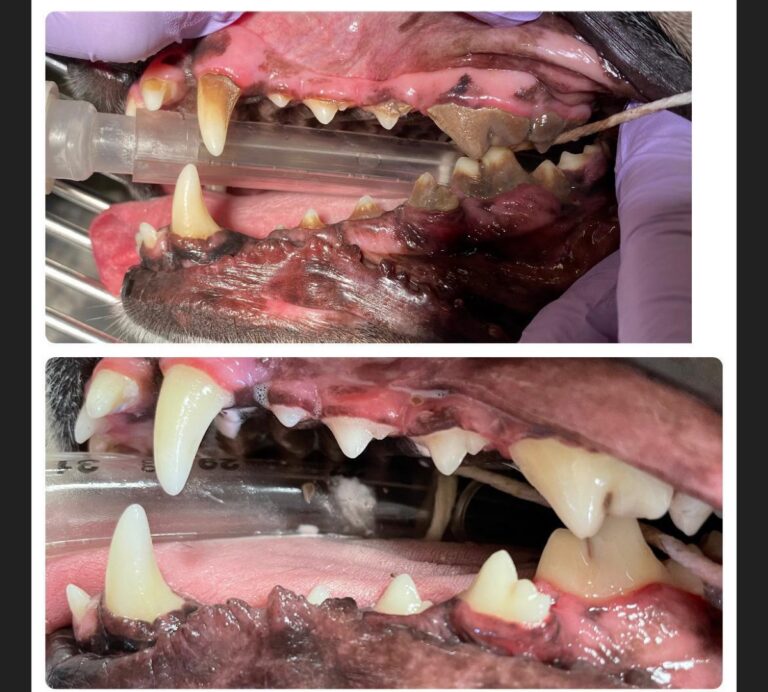
The fourth criterion, scored Important, concerns biological completeness. The canine gastrointestinal tract is a continuum that begins in the mouth, and the oral cavity is the site of the most prevalent infectious disease in the species — periodontal disease, which the American Veterinary Dental College and AVMA estimate affects the majority of dogs by age three. A supplement that addresses only the lower gut leaves this large, disease-prone, upstream niche unmanaged.
What to Look For
A complete profile addresses both the oral biofilm and the intestinal microbiome, recognizing that oral bacteria are continually seeded into the gut and that oral inflammation contributes to systemic inflammatory load. The rationale and the emerging canine evidence for oral-targeted postbiotics — including plaque reduction and oral-metagenome modulation (Florit-Ruiz et al., 2025; DOI: 10.3390/ani15111615) — are developed in our review of the science behind canine oral health supplements. We score this Important rather than Essential because a product can be excellent for a defined lower-gut indication without addressing the mouth; but for a product marketed as a comprehensive daily supplement, oral coverage is a strong differentiator.
Red Flag
A “complete digestive health” claim that ignores the mouth entirely — treating the gut as a closed system beginning at the stomach rather than the continuum it actually is.
Criterion 5 — Stability Data [Important]
The fifth criterion, scored Important, concerns whether the product delivers the same thing at the end of its shelf life that it delivered at manufacture. For viability-dependent products this is a chronic weakness; for inactivated formulations it’s largely a solved problem — but documentation still matters.
What to Look For
Ideally, a manufacturer provides stability data demonstrating that active-component levels hold across the labeled shelf life under stated storage conditions. Multiple reviews confirm that postbiotics are “more stable than live probiotics… less sensitive to temperature, light, and pH” (Hernández-Granados et al., 2024; PMC11321893) and “do not rely on cold chain supply management” (PMC12639491), with storage studies showing peak bioactivity maintained at ambient 15–25°C. A live product, by contrast, should disclose its overfill strategy and refrigeration requirements. We examine why stability outweighs raw count in our article on postbiotic stability and shelf life versus CFU count.
Red Flag
A refrigerated live product with no disclosed overfill factor and no stability data — the label count is then almost certainly not the delivered count by the time the product reaches the consumer.
Criterion 6 — Transparent Sourcing [Important]
The sixth criterion, scored Important, concerns whether the manufacturer discloses where ingredients come from and what “quality” claims actually mean. Transparency is a proxy for accountability: a company that hides behind vague sourcing language is harder to hold to its claims.
What to Look For
Named source organisms with strain designations, disclosed country of origin or manufacturing standard, and precise — not merely aspirational — quality language. The term “human-grade,” for instance, has a specific regulatory meaning: per AAFCO, it may only be used when the product as a whole, and every ingredient, complies with human-food production standards (21 CFR 117), with the USDA AMS PVP Program as the authorized third-party certifier. The phrase “made with human-grade ingredients” isn’t equivalent and, AAFCO warns, “may be false and misleading unless the product as a whole also complies.” A transparent manufacturer uses regulated terms correctly or avoids them; an opaque one uses them loosely.
Red Flag
Proprietary “grade” language that sounds regulated but isn’t, undisclosed sourcing, or quality adjectives unmoored from any verifiable standard.
Criterion 7 — No Proprietary Blends [Essential]
The seventh criterion returns to Essential status and is, in many ways, the gatekeeper for all the others. A “proprietary blend” lists multiple ingredients under a single combined weight, disclosing the components but not their individual doses. This single labeling practice defeats verification: you can’t assess whether an ingredient is present at an evidence-relevant dose if you don’t know how much is there.
What to Look For
A fully disclosed label in which every active ingredient carries its own quantitative amount. Only with full disclosure can Criteria 2 and 3 function — you can compare each dose against the studied effective dose, and a third party can verify each component independently. Full disclosure is the foundation on which the rest of the framework stands.
Red Flag
Any “proprietary blend,” “complex,” or “matrix” that aggregates ingredients under one total weight. However impressive the ingredient list, an undisclosed dose is an unverifiable claim. This is the single most common way a product that looks comprehensive on the front of the label becomes unassessable on the back. We flag this pattern throughout our analysis of why most pet probiotics fail.
The Scoring Matrix
The table below consolidates the framework into a single reference. Use it to score any product against the profile that defines the gold standard.
| # | Criterion | Tier | Pass Looks Like | Fail Looks Like |
|---|---|---|---|---|
| 1 | Postbiotic formulation | Essential | Named strain(s), defined inactivation, viability-independent action | Value rests entirely on a live CFU number |
| 2 | Clinical evidence | Essential | Controlled canine trials, or strong cross-species + mechanism | “Backed by science” with no controlled trials |
| 3 | Third-party testing | Essential | Independent identity/potency/purity testing, multi-batch | Unverified label; “tested” without specifics |
| 4 | Oral + gut coverage | Important | Addresses oral biofilm and intestinal microbiome | Gut-only; ignores the mouth |
| 5 | Stability data | Important | Documented potency across shelf life; ambient-stable | No stability data; undisclosed overfill |
| 6 | Transparent sourcing | Important | Strain IDs, origin, correct regulated terminology | Vague “grade” language; hidden sourcing |
| 7 | No proprietary blends | Essential | Fully disclosed per-ingredient doses | Aggregated “proprietary blend” weights |
Defining the Gold Standard
We define the gold standard as a product that satisfies all four Essential criteria and all three Important ones: a fully disclosed, viability-independent (postbiotic) formulation, supported by genuine clinical evidence, independently verified for identity, potency, and purity, addressing both the oral and gut microbiomes, with documented stability and transparent sourcing. This is a demanding profile, deliberately so. It’s demanding because the evidence supports each element, and because the category is full of products that meet none of them while marketing as though they meet all. The framework isn’t a description of the market average; it’s a description of what the market average should be held to. A product that meets all seven criteria has earned a strong claim to the term “gold standard.” A product that meets only the marketing criteria has earned nothing but skepticism.
Optional Enhancements
Beyond the seven core criteria, several optional features signal additional sophistication without being required for a sound product. These include breed- or size-specific dosing rationale (the canine microbiome shows inter-individual and inter-breed variation), documented palatability and compliance data (the best formulation fails if the dog won’t take it), sustainability and packaging integrity credentials, and a published adverse-event monitoring commitment. None of these substitutes for an Essential criterion, but each adds confidence at the margin.
Common Label Red Flags: A Quick Reference
Several patterns recur often enough to warrant a consolidated warning list:
- CFU as the headline. A live count front and center, with little else, signals a product whose value proposition rests on the least reliable metric in the category.
- The aggregated blend. Any “proprietary blend” defeats dose verification and should be treated as a transparency failure.
- Unspecified “third-party tested.” Legitimate but meaningless without knowing what was tested and on how many batches.
- Loose “human-grade” claims. “Made with human-grade ingredients” isn’t the regulated claim and may be misleading.
- Evidence adjectives without evidence. “Clinically proven,” “vet recommended,” and “advanced formula” aren’t data.
- Gut-only “complete” claims. A comprehensive supplement that ignores the oral microbiome is incomplete by design.
Limitations of Any Framework
A framework is a tool, not a verdict. Several limitations deserve acknowledgment. First, criteria must be applied to information that manufacturers don’t always disclose; a product may be better than its label reveals, though the burden should be on the manufacturer to disclose, not on the consumer to investigate. Second, the evidence base for several criteria — particularly canine-specific clinical trials and oral-plus-gut formulations — is young and evolving; today’s gold standard will be refined as the literature matures. Third, meeting these criteria establishes trustworthiness and evidence-alignment, not a guarantee of individual clinical response, which varies with the host, the existing microbiome, and the condition. The framework narrows the field to credible options; it doesn’t replace individualized veterinary judgment.
Frequently Asked Questions
Why is a postbiotic formulation considered Essential?
Because it removes the viability dependency that undermines so many live products. An inactivated preparation does not need to survive storage or gastric transit to work, delivers a consistent dose, and avoids the label-accuracy problems that plague CFU-based products. The ISAPP formally defined the category in 2021, and canine randomized trials now support its effects. A product whose entire value rests on a live count ties itself to the least reliable metric in the category.
Does a quality seal like the NASC mean a product works?
No. The NASC Quality Seal verifies manufacturing integrity — a quality-control manual, adverse-event reporting, label compliance, and random testing to verify label claims. It does not require or verify clinical efficacy. A product can carry the seal and still be clinically unproven. Treat seals as evidence of good manufacturing, not of benefit.
Why are proprietary blends such a problem?
Because they list ingredients under a single combined weight without disclosing individual doses. You cannot judge whether an ingredient is present at an evidence-relevant amount, and a third party cannot verify each component independently. It defeats the two criteria — clinical evidence and third-party testing — that depend on knowing the dose.
Is “human-grade” a meaningful claim?
Only when used precisely. Per AAFCO, “human-grade” may describe a product only when the entire product and every ingredient comply with human-food production standards, with authorized third-party certification. “Made with human-grade ingredients” is not the same claim and may be misleading. Precise use signals transparency; loose use signals the opposite.
Why does oral coverage matter in a gut supplement?
Because the gut begins at the mouth. The oral cavity hosts the most prevalent infectious disease in dogs (periodontal disease), continually seeds bacteria into the gastrointestinal tract, and contributes to systemic inflammatory load. A supplement that addresses only the lower gut ignores the upstream end of the same continuous system.
Can a single product really meet all seven criteria?
Yes, but few do — which is exactly why the framework is useful. The profile is achievable: a fully disclosed postbiotic formulation with clinical evidence, independent multi-batch testing, oral and gut coverage, stability data, and transparent sourcing. The framework’s purpose is to make that profile explicit so that products can be measured against it rather than against their own marketing.

Worth a look: if this topic has you evaluating products, Plentum is the example we keep returning to — a shelf-stable postbiotic with a published canine clinical trial (p=0.004; doi:10.3390/ani15111596) and full label disclosure. See the clinical summary.
References
- Salminen S, Collado MC, Endo A, et al. The International Scientific Association of Probiotics and Prebiotics (ISAPP) consensus statement on the definition and scope of postbiotics. Nat Rev Gastroenterol Hepatol. 2021;18:649-667. DOI: 10.1038/s41575-021-00440-6.
- Sordillo A, Casella L, Turcotte R, Sheth RU. A Novel Postbiotic Reduces Canine Halitosis. Animals (Basel). 2025;15(11):1596. PMID: 40509062.
- Sordillo A, Casella L, Turcotte R, Sheth RU. An Indole-Rich Postbiotic Reduces Itching in Dogs. Animals (Basel). 2025;15(14):2019. PMID: 40723482.
- Florit-Ruiz A, Rago L, Rojas A, et al. Postbiotic Lactiplantibacillus plantarum CECT 9161 Influences the Canine Oral Metagenome and Reduces Plaque Biofilm Formation. Animals (Basel). 2025;15(11):1615. DOI: 10.3390/ani15111615.
- Bonel-Ayuso DP, et al. Effects of Postbiotic Administration on Canine Health: A Systematic Review and Meta-Analysis. Microorganisms. 2025;13(7):1572. PMID: 40732081.
- Schmid SM, et al. Pilot study evaluating tolerability and changes in fecal microbiota associated with novel probiotic administration to dogs with diarrhea. Front Vet Sci. 2025;12:1720932. PMC12816304.
- Weese JS, Martin H. Assessment of commercial probiotic bacterial contents and label accuracy. Can Vet J. 2011;52(1):43-46. PMC3003573.
- Weese JS. Microbiologic evaluation of commercial probiotics. JAVMA. 2002;220(6):794-797. PMID: 11918274.
- Jugan MC, Rudinsky AJ, Parker VJ, Gilor C. Use of probiotics in small animal veterinary medicine. JAVMA. 2017;250(5):519-528. PMID: 28207322.
- Hernández-Granados MJ, et al. Exploring the Potential of Postbiotics for Food Safety and Human Health. Foods. 2024. PMC11321893.
- Emerging Nonthermal Technologies for the Production of Postbiotics. Foods. 2025. PMC12639491.
- AAFCO. Human Grade Pet & Specialty Pet Food Claim Frequently Asked Questions. aafco.org. 2024.
- National Animal Supplement Council (NASC). NASC Quality Seal. nasc.cc.
- American Veterinary Dental College. Periodontal Disease. avdc.org.